


Diving back in
A few weeks ago, I interviewed Sarah Sturm about collegiate cycling. If you missed it, the key takeaway from our conversation was clear: collegiate cycling plays a critical role in developing the next generation of American cyclists. Ultimately, the current USA Cycling (USAC) sanctioned club structure has not created enough growth for the sport.
To be clear, I don’t place blame or harsh criticism on USAC, they are making the most of the resources available to them. That said, I came to the conclusion that an alternative path should be explored. Specifically, collegiate cycling could benefit by moving away from an exclusively club sport and making a concerted effort to become an NCAA sport. The potential benefits include increased funding, more programs, improved development resources, and greater exposure and legitimacy.
In that article, I explored the benefits and opportunities the NCAA could offer collegiate cycling compared to the current system. One of the most important advantages is funding, which is where we’ll pick up the discussion in this piece.
What are we looking at?
We already know the NCAA is a massive organization that dwarfs USAC, but what level of financial commitment does USAC realistically contribute to collegiate cycling, and how would NCAA classification provide a clearer growth pathway?
To evaluate USAC’s current investment, I reviewed its 2024 Form 990, a tax document which nonprofit organizations are required to file to provide transparency into revenue, expenses, and external commitments.
It’s worth remembering that USAC serves as the governing body for all national-level and categorized cycling in the United States, they do much more than sanction collegiate cycling. These responsibilities include Olympic team selection, organizing national championships, registering riders so they can earn USAC points, and supporting athletes at world championships and other international events. With an annual revenue of roughly $14 million, the key question becomes, how much of that money is actually directed back toward development programs and scholarships each year?
USAC’s current commitment
*All financial information comes from USAC’s 2024 from 990, which covers the period between Jan 1 to Jun 30, 2024.
USAC’s 2024 Form 990 was fairly clear when it came to funding directed toward collegiate cycling and broader domestic development. During the six month period, the total amount in grants awarded to domestic organizations amounted to $22,338, with an additional $27,100 distributed through individual athlete grants. The allocations broke down as follows:
Navajo Technical University: $5,358 (scholarship support)
CT Cycling Advancement Program: $16,980 (youth cycling, not necessarily collegiate)
Individual athlete grants to 15 recipients: approximately $1,800 per athlete
In total, roughly $49,000 was allocated to non-national team development.
For additional context, USA Cycling reported several other major spending categories that do not directly support collegiate programs:
$1,920,481 on international operations (40x the amount of the previously listed grants)
$3,442,864 on athlete development, serving 4,500 athlete days
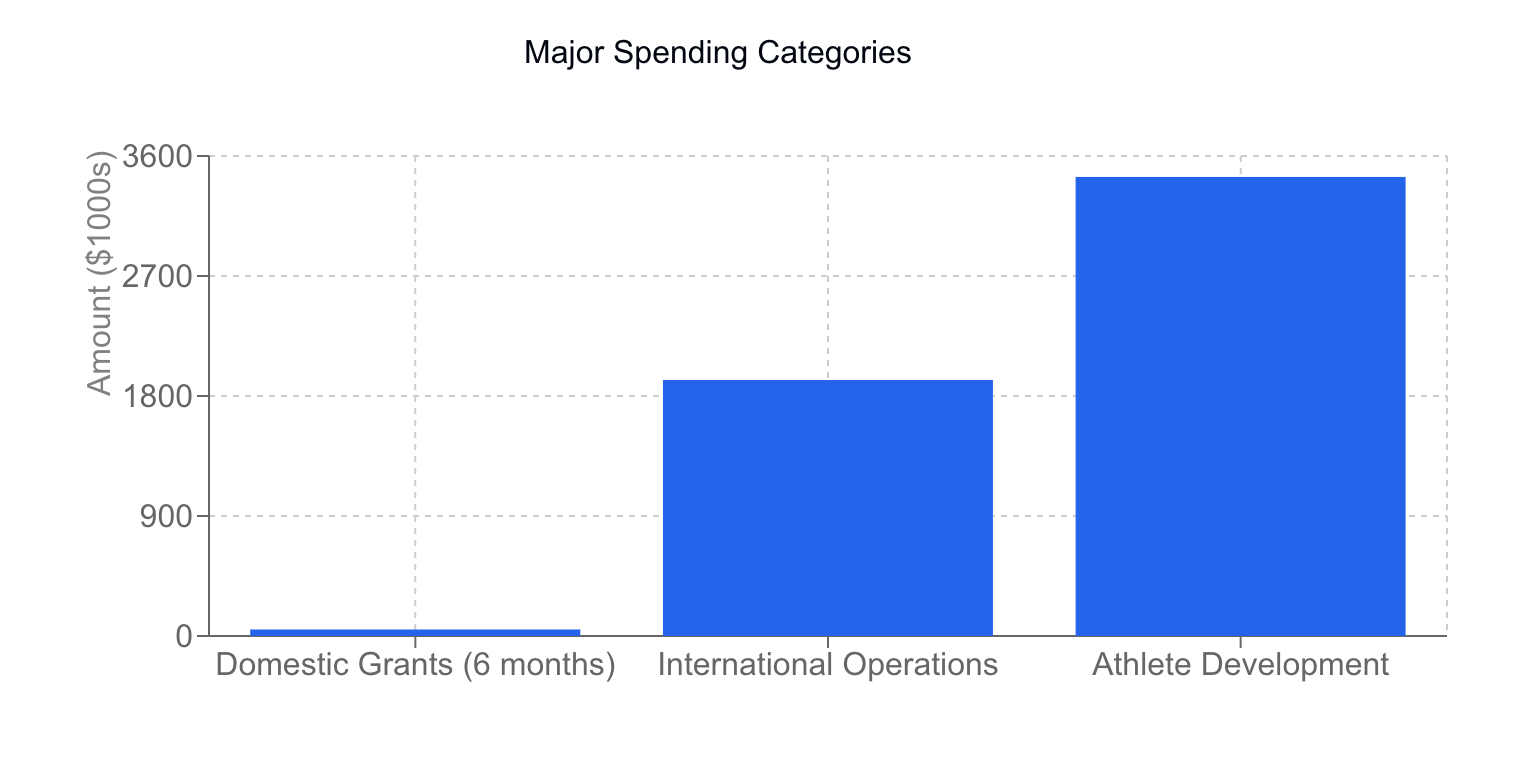
At first glance, the athlete development figure appears substantial, but it can be misleading without context. “Athlete days” is largely an administrative metric that reflects costs such as coach and staff salaries, training center operations, and national events. In practice, this funding supports services and programs that athletes can access only if they are already able to participate, rather than providing direct financial support to collegiate programs or junior athletes.
In total, even if we extrapolate funding across the rest of 2024, USAC would likely contribute around $100,000 towards junior development grants. This is not a criticism of USAC, but rather a reflection of the financial reality that limits its ability to rapidly scale collegiate cycling programs and broader development pipelines.
Why it matters
There are no illusions about cycling being an expensive sport, given the costs of equipment, travel, and entry fees. There is a significant difference between club teams that receive minimal institutional support and varsity teams that benefit from dedicated staff, funding, and resources.
Those additional resources are often a determining factor in whether a sport can transition into the NCAA. In theory, if USAC were able to provide greater funding to non-varsity club teams, institutions might be more willing to invest in a varsity program, causing the gap could narrow. In reality, that level of support does not exist.
Most collegiate club teams receive little to no funding or infrastructure from their schools, which directly limits athlete development. However, there are currently twenty universities that provide funding, coaching, and resources to cycling teams, and these are classified by USAC as varsity programs. This distinction becomes a key factor in evaluating the feasibility of collegiate cycling meeting the criteria required to become an NCAA-eligible sport.
NCAA eligibility
The eligibility requirements for becoming an NCAA sport are actually relatively straightforward. A sport must meet the requirements of an “emerging sport,” which means at least twenty varsity/club programs with 10 being sponsored by schools.
While I don’t have the exact number of varsity cycling teams that are officially sponsored by their university, the number seems to be close, if not already past, ten. If the number of sponsored teams already meet the required threshold, cycling could already be eligible to become an NCAA sport.
Additionally, to become an NCAA championship sport, at least 40 NCAA institutions must sponsor the sport. Collegiate cycling still has room to grow to reach this milestone.
As much as I want to scream, send it, become an NCAA sport! I realize there are levels to this proposition. In my Sarah Sturm story, I detailed some of the challenges facing “olympic” NCAA sports, and some of the old fears that new NIL rules alleviate, but what other reasons might a sport want to remain at the club level?
Why remain a club sport?
Until I have more conversations with USAC staff, I won’t fully understand why collegiate cycling hasn’t pursued NCAA status. There are several reasons a sport might choose to remain at the club level though, including:
Niche appeal
Lack of traditional childhood development pipelines
Desire to maintain skill inclusivity
Retaining student control
Universities refusing to sponsor a sport
Disproportionate time commitments compared to other sports
Decentralized competition structures
Most, if not all, of these factors apply to cycling, making it understandable why remaining a club sport has long been seen as the best route. And who knows? Maybe I’m wrong and the club structure is the right path.
However, it’s hard to ignore stagnation in the sport, particularly in the number of professionals and the quality of results we produce as a nation at the pro level. Being the risk-accepting entrepreneur I am, my instinct is to take the leap and say, let’s at least try something drastically different. It might not be all or nothing though, maybe there could be a compromise.
Is gymnastics our guiding beacon?
While considering sports with a similar structure to cycling gymnastics came to mind. Gymnastics has a national governing body and is also a NCAA sport. As I looked into how USA Gymnastics (USAG) works with the NCAA, the learning opportunities for cycling became clear.
Here’s a basic rundown of how USAG and the NCAA collaborate:
The NCAA generally follows USAG’s sanctioning rules for collegiate events, though rules can vary by discipline.
NCAA schools can register as USAG members, allowing their athletes to remain eligible for USAG events and international team selection.
Both USAG and the NCAA host separate championships, which spreads the reach of the sport.
The organizations partner to promote NCAA collegiate gymnastics as a professional pathway.
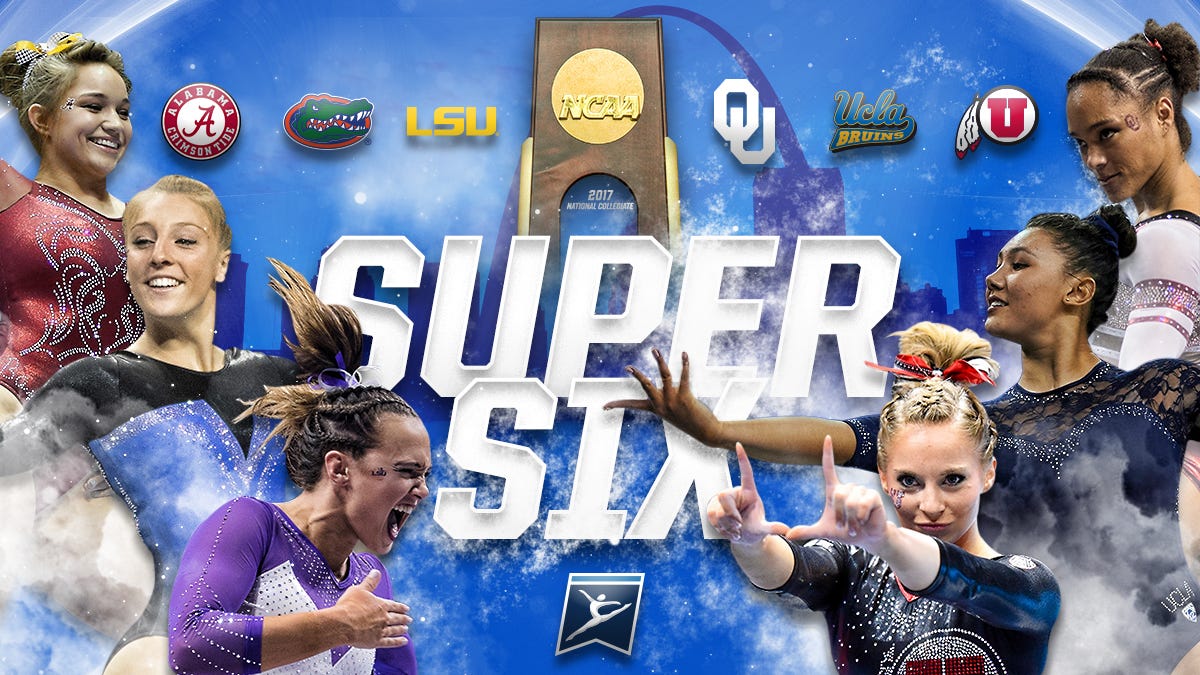
I could—and likely will in a later release—dig deeper into the similarities and differences between USAG and USAC’s approach to collegiate athletics. In short, USAG managed to relinquish complete sanctioning control and compromise with the NCAA to create a system that:
Better supports growth from youth development through professional competition year after year
Provides more financial and training resources to more athletes
Allows USAG to focus on optimizing international/Olympic teams and youth programs
Leverages the NCAA’s influence to bring greater legitimacy to the sport domestically
It’s important to note that gymnastics has far higher participation numbers than cycling, and USAG is a significantly larger organization with more financial resources compared to USAC. If such a major organization sees the need and benefit of delegating responsibilities to outside partners, it raises the question of why a much smaller entity like USAC hasn’t explored a similar approach.
I will hopefully have answers for you soon ;)
Using what we have
If a partnership between USA Cycling and the NCAA is the solution, what steps could be taken now to get the process started? Much of it comes down to simplification and prioritization to ensure a smooth and effective transition.
What disciplines should be included in the NCAA?
USAC needs to identify which cycling disciplines should be part of NCAA competition. Road racing and mountain biking are obvious starting points given their popularity, spectator appeal, and cross-discipline viability. While it would be ideal to include every discipline, universities need a clear, achievable focus to meet NCAA requirements.
Coordination
If this idea has even partial support within USAC, conversations with the NCAA need to start immediately. Coordination with the NCAA and even USAG will be crucial to share insights and develop competition structures.
Incentivizing adoption
USAC needs to find ways to convince major universities to sponsor varsity cycling programs. For instance, USAC could reallocate funding to provide grants or other support to Division I universities that choose to sponsor NCAA cycling programs.
Cut the fat
USAC should review its budget to determine where funds are currently going, assess which activities most directly benefit collegiate cycling, and identify areas that could be delegated to the NCAA.
These are broad strokes for a monumental task, but they provide a starting point for ideas and action. Either way, this is a topic that will continue to be explored in this newsletter.
A note and some exciting news
This article probably raised more questions than answers, and that’s a good thing. It means we have so much more to explore, unpack, and ideate on.
So, after writing two pieces on collegiate development, it’s become something I think about almost every day. It’s a topic I’ve grown deeply interested in and one where I believe I can have a real impact. Going forward, I plan to dedicate more time to it in future editions and ultimately develop it into a recurring series called Foundations.
The exciting news

As of writing this piece, two major announcements have emerged around collegiate cycling in the United States. First, high school racing will be added to three collegiate national championships, creating more scouting opportunities for rising junior athletes. Second, the first-ever collegiate gravel national championship will be held at Valley of Tears Gravel, further legitimizing the discipline.
Ride and rip,
Kyle Dawes
You would think it would be a low cost investment on a university’s behalf given that, as long as we’re not talking about track cycling, there’s no need for an upfront investment in a facility or to have a separate field or to find real estate on campus. Somewhat related to that but on the flipside, given that training and competition would take place largely off campus property, especially in the case of public roads, does that open up the university to additional risk in the form of injuries, liability, litigation and what kind of insurance would be required?
Many international students come over to the NCAA system for Olympic sports because of the highly developed NCAA infrastructure and support provided to the student athlete. And given that cycling development in the US appears to be particularly weak in this 18-23 age range, this would seem like a no brainier.