


Hot off the heels of the Tour de France, the Tour de France Femmes Avec Zwift kicks off in less than 24 hours. The race packs all the excitement of the men’s event into nine stages and features just as many star athletes across sprint, mountain, and breakaway stages. Despite receiving less overall airtime than the men’s race, a strong case can be made that the Femmes is the most important race on the entire WorldTour calendar, men’s or women’s.
Yes, the men’s Tour still outperforms the women’s in total viewership. But how does it compare when you factor in economic and social opportunity? Whether you are a sponsor looking for airtime or someone like me who wants to grow cycling in the United States, measuring a race’s potential impact through total viewership alone is short-sighted and misses the fuller picture.
Since 2020 there has been a seismic shift in the US sports market. Women’s sports are seeing rapid growth in fandom, brand investment, and professional athlete development at a rapid pace. The best part is that this growth is widely considered to be just the beginning of a sustained period of hypergrowth for women’s sports in the United States and globally. The question worth asking is whether this momentum extends beyond mainstream sports.
As we will uncover, the characteristics driving the US women’s sports market create conditions where a more niche sport like cycling could actually thrive over the coming years. The Femmes provides a platform that could finally allow cycling to resonate with mainstream American sports audiences. The market conditions we will explore create an environment where women’s cycling could generate a flywheel effect, drawing more US capital into the sport and building a more robust domestic talent pipeline.
Drawing on comprehensive market research from McKinsey and Bank of America alongside Zwift’s direct polling of Femmes viewers, this piece breaks down the current state of the US women’s sports market, the real impact of the Femmes, and why women’s racing could be the key to unlocking cycling’s next phase of growth in the United States.
Methodology
There is a lot to unpack before diving into how we use the Femmes to grow cycling in the United States. This piece is broken into four sections:
Establishing the current market dynamics for women’s sports in the United States
Looking at the current impact of the Femmes
Understanding what the two mean in tandem
Discussing how this understanding can inform real action and drive cycling’s growth in the United States

Built on Bikes has always taken a bullish stance on what women’s cycling could mean for this country. Previous pieces laid out why the United States is capable of becoming the dominant nation in the Women’s WorldTour. Today the goal is to make sure that when that success arrives, people will actually be there to see it.
The current state of women’s sports
The following insights come from two separate market reports, one from McKinsey & Company and one from Bank of America. The McKinsey report focuses specifically on the US market while the Bank of America report captures a global perspective. Their scope varies, but both arrive at the same conclusion: women’s sports are growing rapidly and becoming an increasingly significant force in the US and around the world.
McKinsey (2025) - Closing the monetization gap in women’s sports
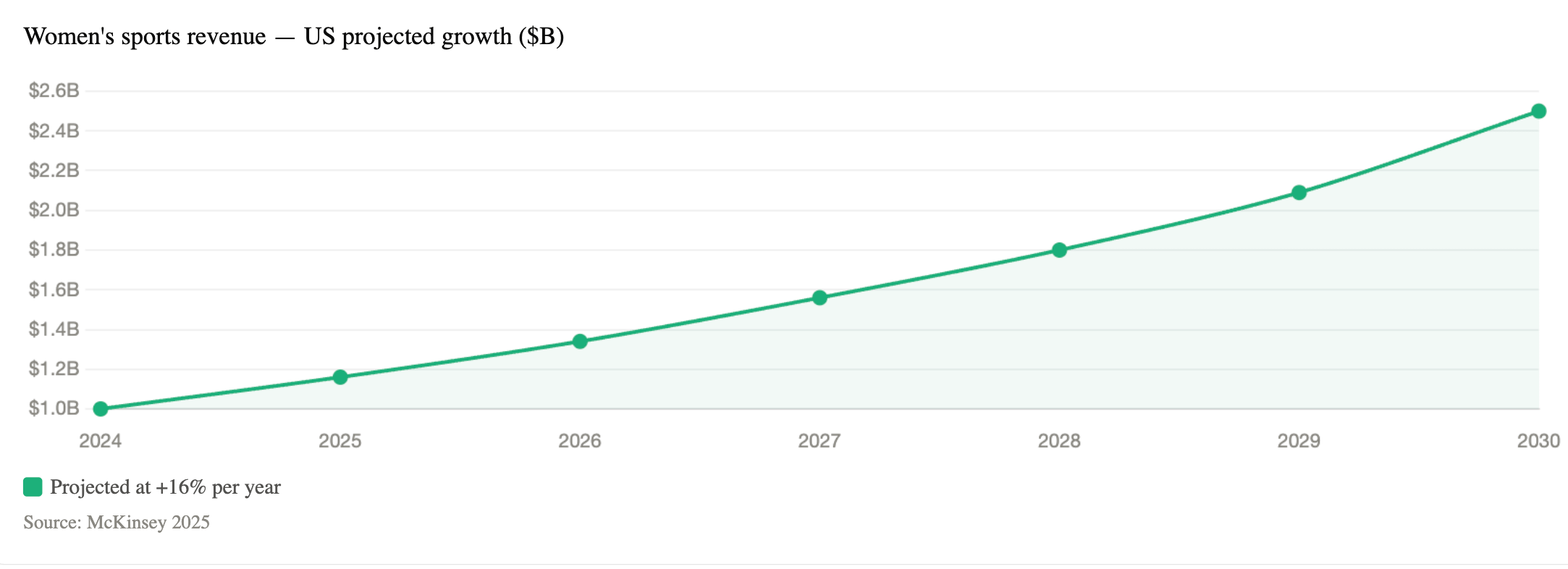
McKinsey’s findings come from a study of 3,003 US sports fans and dozens of large companies that actively invest in sports marketing. The report establishes the growth potential of the women’s sports market by noting that professional women’s sports generated $1 billion in revenue in 2024, representing less than 2% of the $75 billion US sports market. By 2030, revenue from women’s sports is projected to reach $2.5 billion, growing at 4.5 times the rate of men’s sports over the same period. The four revenue streams driving that growth are:
Brand sponsorships
Ticketing
Broadcast media rights
Merchandise
The figures make a confident case that growth is accelerating and we are still in the early stages. Cycling’s contribution to these numbers is almost certainly negligible, but that is where the opportunity lives. With such a large and expanding pie, smaller sports have real room to capture outsized returns from investment.
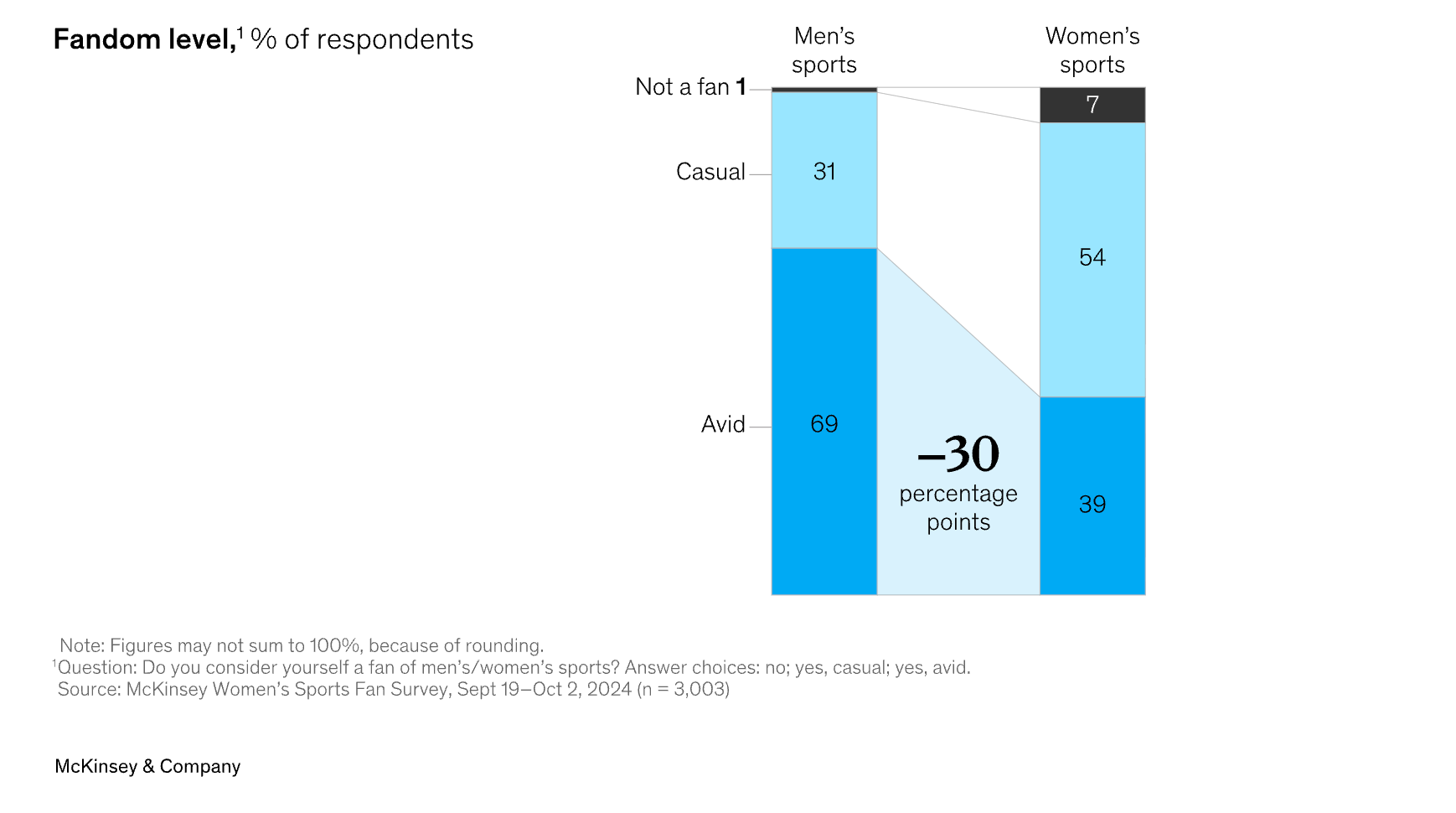
The demographics of women’s sports fans are where things get particularly interesting.
Women’s sports fans are almost exclusively existing fans of men’s professional sports, with 99% of respondents saying they were already sports fans before adding women’s sport to their watchlist. They are not new to sports, but they are genuinely engaged. 39% already identify as avid followers of women’s sports. While there is a 30 percentage point gap between the number of avid fans of men’s sports and women’s sport, the amount of avid fans of women’s sport will grow over time and translate into meaningful consumer behavior. Avid fans are 27% more likely to purchase from brands that endorse female athletes, and the word athlete matters here: 45% of avid fans say their loyalty is to individual athletes rather than teams.
A recurring argument across Built on Bikes is that compelling storytelling is essential to cycling breaking into the mainstream. These market dynamics suggest that women’s cycling could become a genuine value add for sponsors, provided the storytelling infrastructure is there to support it. In one of its closing findings, McKinsey identifies major international events as the largest single driver of new fandom growth in the US, which bodes well for an event like the Femmes.
Finally, McKinsey outlines four barriers to effective monetization in women’s sports:
Fragmented fan attention
Fewer avid fans
Lack of viewing access
Lack of market maturity
All are real barriers to the growth of women’s sport, but given the promising numbers already presented, these barriers could represent an opportunity for a smaller and more niche sport to outmaneuver larger players in addressing them.
Bank of America (2026) - The business of women’s sport’s
Released in March 2026, this Bank of America report takes a closer look at the economic trends driving the growth of women’s sports around the world. It combines Bank of America’s proprietary consumer spending and account data with broader market research. On a macro level, the economic power of women is growing considerably. By 2028, women are projected to control $32 trillion in discretionary spending globally.
The report also surfaces more granular demographic detail on women’s sports fans. On average, fans of women’s sports are younger, more educated, and more affluent than those who follow only men’s sports. They are also more digitally engaged, which presents greater opportunity for sponsors and athletes to connect with them across multiple channels.

From a commercial perspective, women’s sports have a compelling ability to attract capital. For every $1 spent on sports marketing, $7 in customer value is generated. At the institutional level, investors are allocating more toward female-focused investment mandates. Bank of America estimates that over $4 billion in equity assets under management is now directed toward women’s initiatives. Only a fraction of that will flow to women’s sports specifically, but it signals that women’s sports will have an added angle when making the case to investors.
The current impact of the Tour de France Femmes
The market for women’s sports is favorable and growing, but where does an event like the Femmes fit into that environment today, and is it positioned to ride the market tailwinds? Understanding the race’s current influence is essential, and fortunately both Escape Collective and Zwift have published figures that give us a clear picture of where things stand.
Escape Collective (2026) - How many people really watch the race?
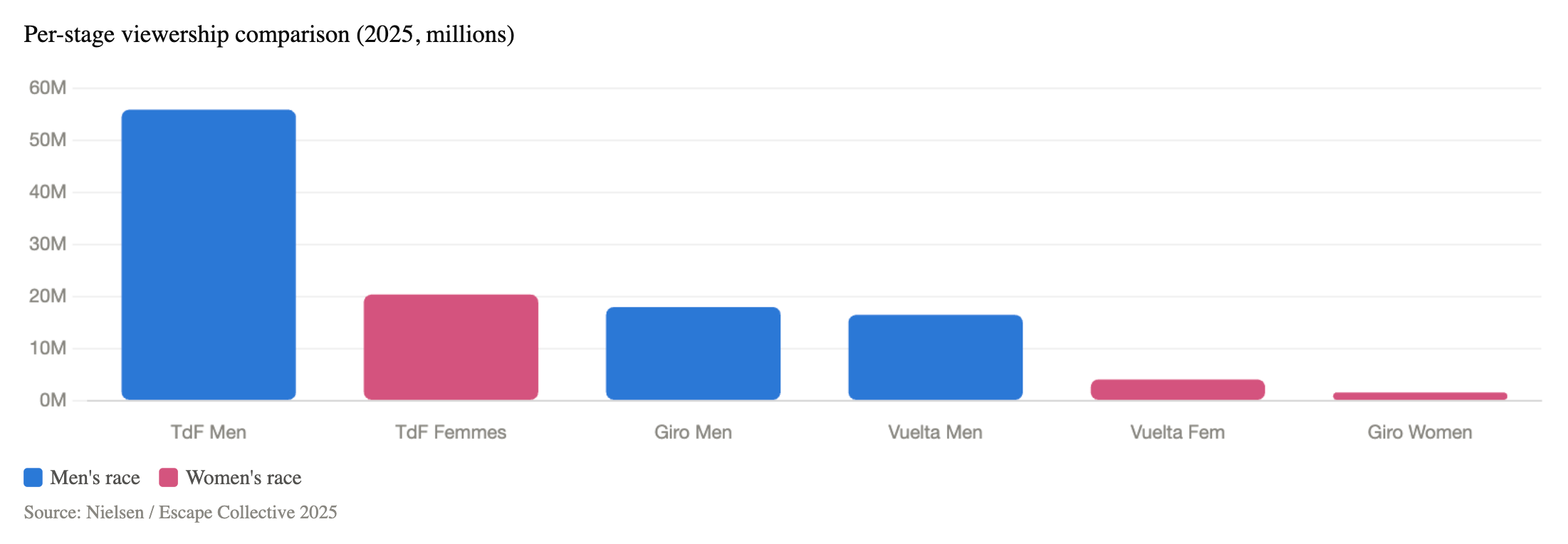
We already covered the viewership findings from this article for the men’s Tour, but the women’s Tour stats are incredibly impressive when viewed in the context of the wider WorldTour calendar. During the entire Women’s WorldTour season, 61% of all viewership happens during the Femmes. On a per-stage basis, a single stage of the women’s Tour draws more viewers than a stage of either the men’s Vuelta a España or the Giro d’Italia. If we are looking for the silver bullet event to build on for viewership, the Femmes is the best option by far.
As has already been stated, viewership is just one piece of the puzzle — if an event can’t influence viewer behavior, opportunities fade fast.
Zwift (2025) - Where are we now? Four years into the Tour de France Femmes Avec Zwift
Following the 2025 edition of the Femmes, title sponsor Zwift conducted an analysis of 5,030 viewers across the US, UK, France, and Germany. The goal was to understand how the race has influenced viewers and shifted their perspective on women’s cycling. The findings were striking.
52% of female respondents described the Femmes as inspiring. At 69%, an even larger group said they felt inspired to ride a bike in the future, and 80% said they are more likely to watch women’s racing again. The network effects were also apparent, with 41% saying they have encouraged others to watch women’s racing.
The most significant data point may be that 17% of respondents said they bought a bike as a direct result of watching the race. That is a meaningful impact on consumer behavior and, depending on the aspirations of these new riders, a potentially significant contribution to the development of the sport.
Consistent with McKinsey’s findings, Zwift identified viewing access as the biggest barrier in the US, with the majority of American viewers relying on social media and streaming rather than traditional broadcasting. This reflects the broader shift toward streaming across sports generally, and it is also where cycling has a real opportunity to outmaneuver other women’s sports.
Putting it all together
The McKinsey and Bank of America reports combined with the viewing and impact data from the Femmes have set the backdrop for understanding how the race fits within the broader women’s sports market. The viewing data makes one thing clear: the Femmes is the standout event for women’s cycling and arguably the only race with enough reach to make a genuine push into the mainstream of women’s sports in the near term. To be clear, every women’s race deserves an audience, but when it comes to marketability and immediate impact, the Femmes stands head and shoulders above the rest.

So how do we start connecting the positive signals from the market to the Femmes in a way that produces meaningful growth for the sport? The most useful way to frame this is across two areas: economic and sporting. Without capital flowing into and through the sport in the US, there will be no growth. And without the race inspiring and developing more athletes domestically, the commercial opportunity will have nothing to build on.
Playing off the market - economics
There are strong positive signals in the women’s sports market that the Femmes can build on, but addressing some of the structural challenges facing the market could give women’s cycling an immediate advantage over more mainstream sports like basketball and soccer. McKinsey’s four barriers to monetization are worth examining closely, because working through them reveals the outline of a compelling business strategy for the race.
Fragmented attention
When McKinsey talks about fragmented audience attention, it primarily means women’s leagues competing with their men’s equivalents for the same viewers. The WNBA has only minor overlap with the NBA season, but the NWSL competes directly with MLS for much of the year. Fragmentation is a genuine challenge for most women’s sports, where established men’s leagues continue to set the default viewing agenda.
For the Femmes, this problem largely does not exist. There is no overlap with the men’s Tour, and the race has the added advantage of beginning immediately after it ends. Viewers do not have to choose between one or the other. If new fans discover the men’s race and love the experience, that momentum has a strong chance of carrying directly into the Femmes.
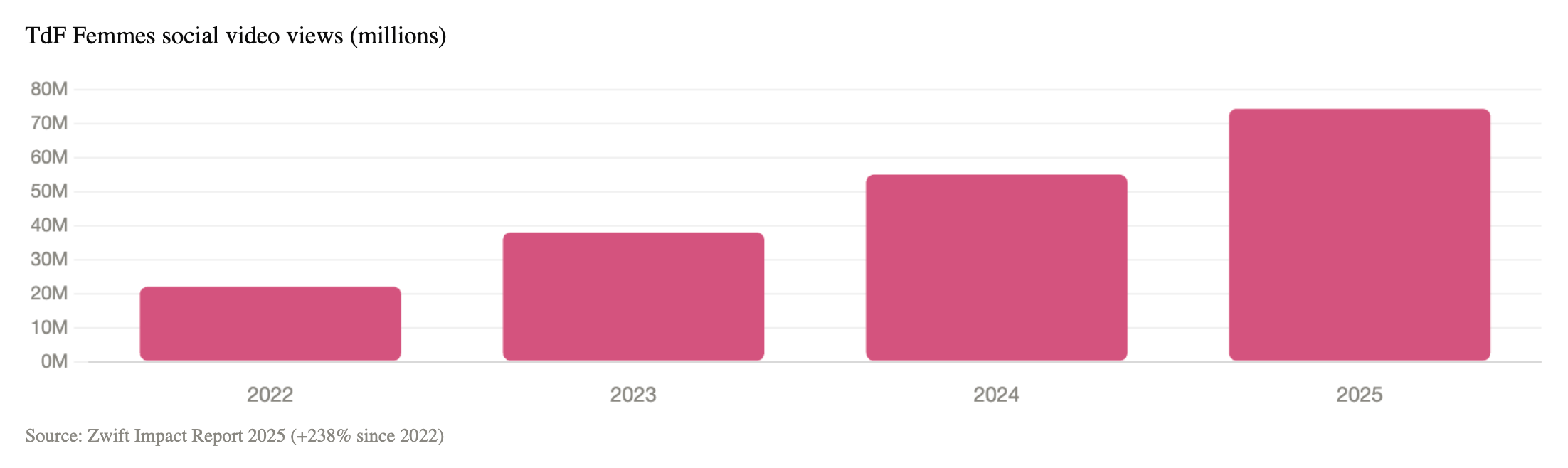
The other dimension of fragmented attention is the effect of social media on shortening viewing windows across all sports. Match-based sports are best experienced live, and most leagues have responded by leaning into social media as a highlight distribution channel, reposting clips from live broadcasts and not much else. Cycling feels genuinely different in how it has embraced the platform. Yes, broadcast clips get reposted, but for every official clip that goes out, a wave of fan-generated media follows, covering angles the broadcast never touched, from a pro watching off the bike to a spectator on the side of a mountain pass watching the race arrive right in front of them.
It is intimate, unfiltered, and remarkably effective at surfacing the stories buried inside a race. If cycling continues to embrace social media the way it already has, capturing and holding audience attention becomes a much more realistic proposition.
Fewer avid fans
As any cyclist knows, once you get into the sport, whether through watching races or riding yourself, you become hooked quickly. For better or worse it becomes a core part of your identity. It may take longer to convert someone into a cycling fan than into a fan of a more mainstream sport, but once you do, that fan tends to be deeply invested. Zwift’s data supports this, and if women’s cycling can convert more people into genuine fans, the sport could realistically outperform the industry average of 39% avid fandom. As with the women’s sports market broadly, avid fandom translates directly into purchasing behavior, which means more mainstream brands will follow the sport that produces the most committed fans.
Lack of access
Without a doubt, this is the most significant barrier for women’s cycling in the United States. The Femmes is streamed via Peacock, NBC’s streaming platform, but for anyone without a subscription the race remains difficult to find. Counterintuitively, access may be more of a lagging indicator than an immediate problem to solve. NBC holds the US licensing rights and has historically been the broadcaster of the Tour de France in this market. Until viewership numbers create enough commercial pressure for other platforms to compete for those rights, meaningful access expansion through traditional broadcasting is unlikely in the near term.
This is where social media becomes the most critical tool for establishing women’s cycling in the US. How it ultimately counteracts the access gap comes down to storytelling: getting social media users to connect with an athlete on an emotional level and nurturing that investment until they are motivated to seek out the race themselves.
Lack of maturity
For cycling, the Femmes has already proven that maturity is less of a barrier than it is in other women’s leagues. After only four editions, the race already outperforms the men’s Giro d’Italia and Vuelta a Espana on a per-stage basis. If maturity is the reason investors and sponsors are holding back from other women’s sports, the Femmes should be a clear exception to that logic. Four years in, the race draws more than a third of the per-stage viewership of the men’s Tour. The trajectory from that starting point is genuinely exciting.
The four barriers to monetization present real challenges for the Femmes and women’s cycling, and none of them will be easy to overcome. But there are clear ways to address each one. Ultimately, the biggest economic lever is attracting sponsors who can inject capital into the sport and broaden access. How the Femmes attracts those sponsors comes down to fan influence, and that ties directly into developing the next wave of female cyclists in the United States.
Influence is power
The United States can become the dominant nation in women’s cycling, but getting there requires growing the wave of women entering the sport, and the Femmes provides the most powerful storytelling platform available to do that. There are two complementary interests at play. First, the Femmes needs to drive enough fan influence to attract sponsor capital into the sport. Second, that influence needs to translate into more women racing bikes domestically. We’ve seen women like Kristen Faulkner come to the WorldTour later than others and produce incredible results, increased reach for the Femmes could inspire more women like her in the future. The more elite athletes the US produces, the more fans tune in, and the more brands want to invest in athletes and teams.
We know that women’s sports drives higher fan engagement with individual athletes and moves nearly a third of fans to engage more meaningfully with brands that endorse female athletes. We also know that the Femmes alone encouraged 17% of women watching to go out and buy a bike. For both economic and developmental impact, individualism is the single most important lever available. If the Femmes wants to significantly expand its influence and reach, an aggressive focus on the stories of individual athletes is not just a nice to have. It is the strategy.
That logic applies to men’s cycling as well, but with proven consumer behaviors tied specifically to women’s sports, the Femmes is where cycling should focus first. Building that individual athlete narrative can happen in several ways: promoting athlete social media accounts during broadcasts, producing short-form content on riders to fill lulls in racing, and showing how athletes interact with sponsor products in authentic settings. Each of these is a meaningful lever for growing the Femmes’ influence among business entities and with prospective athletes.
Watch the Femmes!
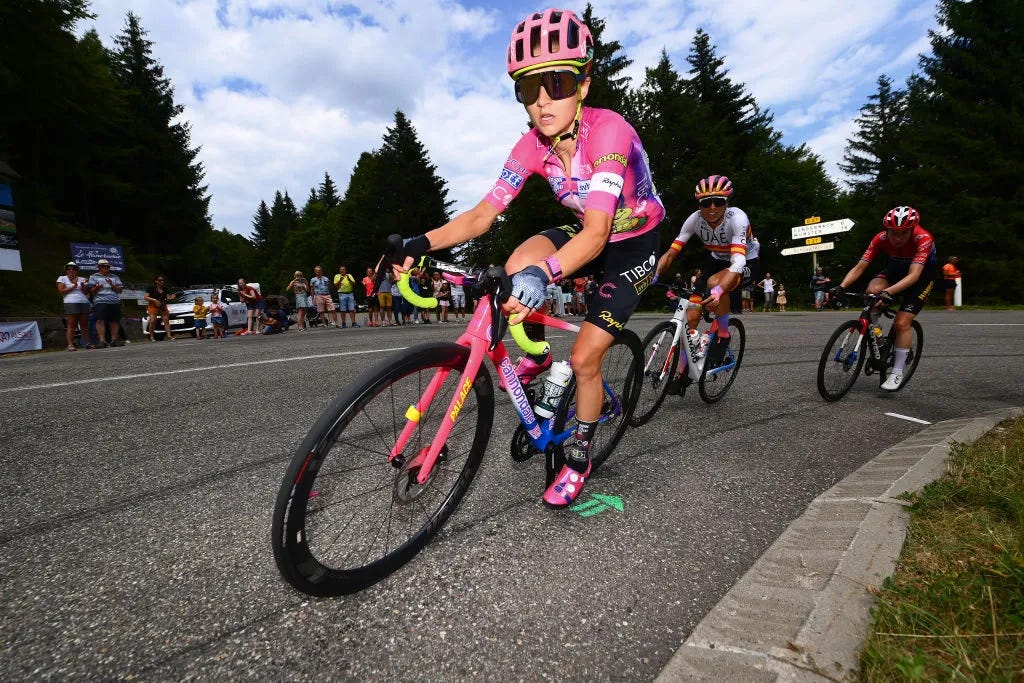
The stage is set and the case has been made. The action, rivalries, and stories within the women’s peloton create a genuinely different sporting experience from the men’s equivalent. The market for women’s sports is growing and evolving in ways that men’s sports is not. The Tour de France Femmes should embrace those differences, zoom in on individual competitors, and invest seriously in branding over the next five years.
Whether there will be enough people in positions of power with a genuine interest in growing cycling in the US is an open question. But the roadmap to growth is less complicated than it might first appear. And if you have read this far, one of the most direct things you can do to move the needle is simple: watch the Femmes!
Ride and rip,
Kyle Dawes

Good take Kyle. I agree!
Great article, I’m having a very difficult time believing that 17% data point though. How small was the sample size?