


As promised, we are back with a second piece this week. Besides releasing two stories, it has been a time-crunched week. I only had a few days to write, so logically I picked a topic that is complex, dry, and probably deserving of a very long and analytical article. I figured it might make more sense to explore this week’s topic with a shorter, hard-hitting piece. Instead of delving into countless rabbit holes, just exploring the facts and possible solutions will bring you up to speed on a topic that you have probably never heard of.
The original research angle for this piece was analyzing the current landscape of athlete management agencies across the men’s and women’s WorldTour pelotons. When researching that subject it quickly became clear that there is an extreme lack of rider representation data for the Women’s WorldTour. Athlete management of the Women’s WorldTour is relatively new and just now starting to take off, with The Cyclists Alliance reporting that only 47% of riders are being represented by a 3rd party. A reason for that might be the topic we discuss in this piece.
While researching that topic my attention was drawn to something else entirely. The systems set up to secure certain rights for riders look very different between the men’s and women’s pelotons. These are systems that secure standard contract obligations, including minimum salaries, insurance, and leave, and that negotiate structural changes for the sport, including rule changes and safety regulations. The way riders and teams are represented, and the way they negotiate with the UCI, are completely different. In the simplest terms possible, the men have a seat at the table with collective bargaining power while the women have decisions handed down to them. In this piece we will look, concisely, at rider representation and collective bargaining power between the men’s and women’s WorldTour pelotons.
Collective bargaining in the men’s WorldTour
The way riders in the men’s peloton reliably negotiate standards with both teams and the UCI is through collective bargaining and joint agreements. This is how most sports leagues work, with player unions, team associations, and governing bodies. In the WorldTour, every two years representatives for both riders and teams meet to discuss a joint agreement that outlines the standards we mentioned earlier.
The parties involved are the Cyclistes Professionnels Associés (CPA) and the Association Internationale des Groupes Cyclistes Professionnels (AIGCP). The CPA acts as the riders’ union and the AIGCP acts as the teams’ association. The current agreement came into force in 2024, and it is still the one in effect (more on this shortly). Its scope comes down to Article 1, which states:
“This agreement establishes the standards governing the working conditions of riders employed by a team registered or intending to register with the International Cycling Union (known by the French acronym UCI) as a UCI WorldTeam or a UCI ProTeam under Chapter XV or XVI of Part II of the UCI Cycling Regulations. “
In plain language, the joint agreement only applies to men’s WorldTour and ProTeam squads. Article 1 also caveats the agreement in the event of inconsistencies, saying the UCI regulations shall prevail in such instances. The agreement is meant to build on top of the rulebook rather than replacing it.

Other important articles in the agreement include:
Article 5 - defining a standard contract
Article 8 - forbidding trial periods with riders before signing them
Article 10 - setting minimum salaries and establishing a salary freeze if negotiations stall for future seasons
Article 18 - access to the CPA union and the ability to attend meetings with no consequence from their team
Article 21 & 22 - establishing sick pay standards and insurance floors
The men’s joint agreement represents years of work and collaboration between riders and teams to achieve “fair” employment standards and advocate for riders’ best interests. It follows a simple structure that mirrors other sports leagues. The two representing parties are the definitive representatives for riders and teams, with no other intermediaries complicating the arrangement.
One would think the same arrangement is in place for the women’s peloton, but a 2026 salary freeze made it very clear that the process is different for women.
The 2026 salary freeze
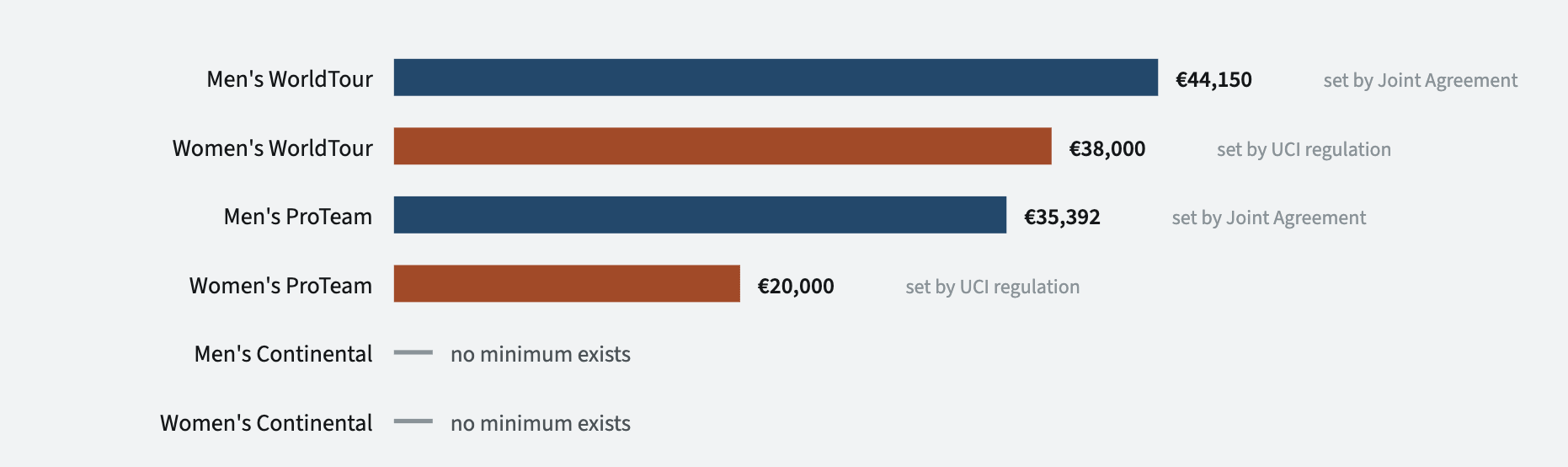
In January 2026 the UCI confirmed that there would be no changes to the minimum salaries for either the men’s or women’s WorldTour. How that result came about looks very different on each side. For the men, it was a negotiation, and it followed the terms of the joint agreement between the CPA and AIGCP. At the time, CPA president Adam Hansen said the union was prioritizing broader structural reforms, including safety protocols and insurance standards, over immediate base-pay raises. That means the 2025 base salaries remained in effect. This outcome was intentional, and essentially a trade for future improvements elsewhere.
For the women, the freeze was an announcement. This is because the CPA has no oversight of the women’s minimum salary, or anything else in the women’s peloton. There was nothing to negotiate because there was no one to negotiate with.
How is this possible and is it as bad as it appears?
At face value, the information I just presented sounds bad, but there are several nuances to the issue. There are organizations representing women and even influencing UCI regulations and decisions. The detail that matters here is that they are doing that lobbying alone. There is no collective bargaining agreement between a women’s rider union and women’s team association.
That is why the decision to freeze the women’s base salaries came from the UCI directly. The women’s rider union may have been pushing for salary increases but at the same time, the women’s teams association may have been pushing for the opposite. That is a complete hypothetical, but goes to show how no open line of communication can affect the outcomes for the women’s peloton.
Who represents the women?
If there are representatives for both riders and teams that have seats at the table with the UCI, why is there no agreement? Before getting into the most likely answer, it helps to understand the landscape of unions and associations. While the men have the CPA and the AIGCP, the women have a few more players in the mix.

First, the recognized representative for the women is CPA Women, an offshoot of the CPA. CPA Women receives UCI funding and has claimed that they have lobbied successfully for things like extreme weather protocols, resisting wage cuts during Covid, maternity recognition, and reviving the Tour de France Femmes. CPA Women has UCI recognition, but there is another association that works extensively with women’s riders.
The Cyclists’ Alliance (TCA) is a union formed in December 2017. TCA surveys riders, provides legal services that were used by over 100 riders in 2025, and has established mentor programs. It was formed ten months after TCA Co-founder Iris Slappendel met with the CPA in February 2017. In unofficial accounts of that meeting, the CPA dismissed her concerns and advocacy for women’s cycling, asserting that it did not consider women to be professional. Just five months after that meeting, CPA Women was formed in July 2017. Today CPA Women describes itself as the only international association of professional female riders, a claim TCA’s existence clearly contradicts.
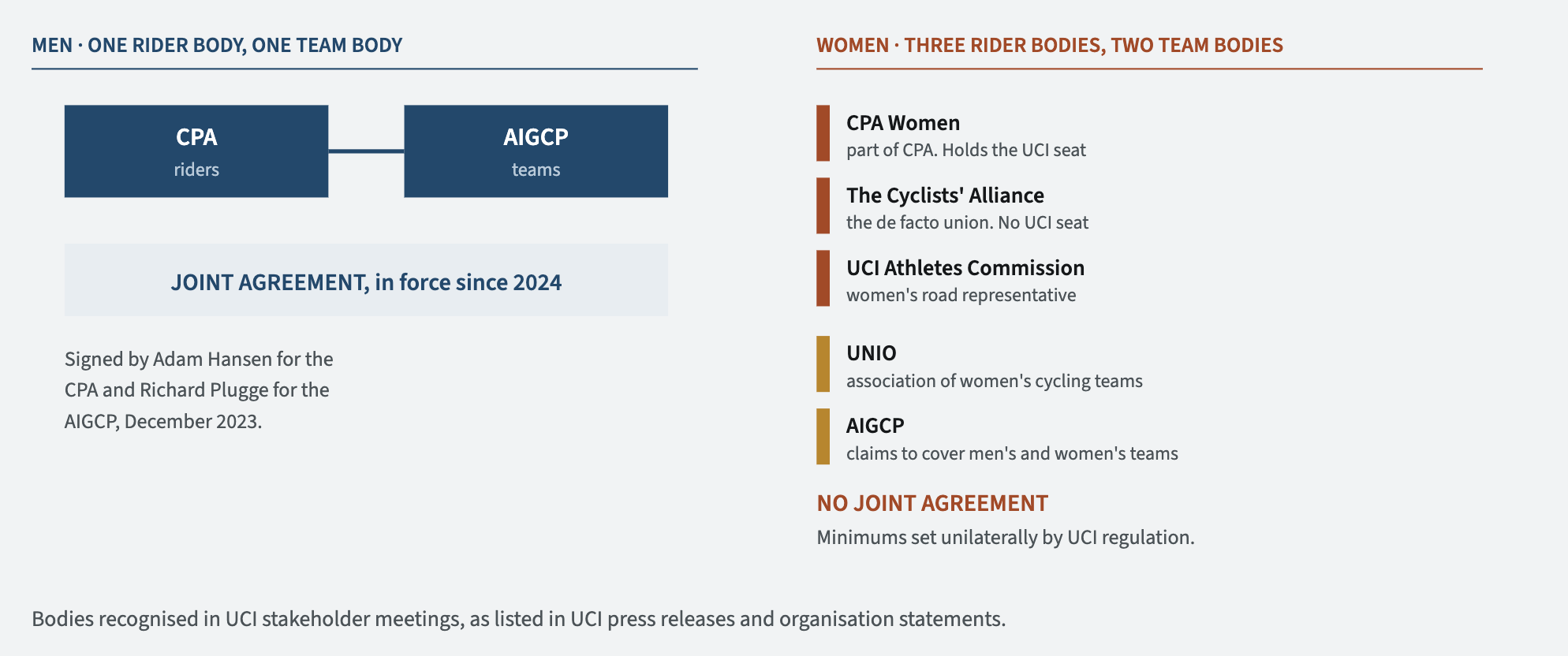
There is also a UCI Athletes Commission, an advisory body within the UCI that gives active riders a recognized channel to advocate for their fellow athletes with the UCI directly.
The situation is similar for women’s teams. The AIGCP claims to cover men’s and women’s teams, but another association called UNIO was created specifically to represent women’s squads. It is unclear which association has done more in recent years, but it is a notable detail.
Why is there no joint agreement for collective bargaining power?
Besides the existence of several groups claiming to represent women’s riders and teams, why is there no agreement between bodies that would create stronger bargaining power with the UCI? The two organizations that have already partnered for the men both claim to represent women and are recognized representative parties in women’s cycling, so why have they not agreed to anything?
There could be a range of reasons, but the most likely comes down to money being hard to come by for women’s teams. Unlike the men’s WorldTour, women’s teams operate on much tighter budgets and will be far keener to keep salary minimums as low as possible. A representative for the teams would argue the situation is not ideal, but the financial reality is that higher required salaries would do more harm than good and cause teams to disappear.
So why would the AIGCP sign an agreement with the CPA for the men? One documented reason is that the joint agreement was built into the official registration process for teams. The rest come down to things that benefit teams as much as riders.
Salary floors protect the well-funded. They keep lower-budget teams from fielding cheap riders and undercutting on cost.
Predictability is worth paying for. Standard contracts, defined notice periods, dispute guidelines, and free mediation benefit both teams and riders.
Leverage. The men’s peloton can withhold labor at a grand tour and there would be massive financial consequences. At races other than the Tour de France Femmes, the riders have less perceived leverage.
We cannot know the true reasons right now, but this context should make it clearer why the respective parties in women’s cycling don’t see enough mutual benefit in a joint agreement yet. The system for the men’s peloton is not perfect, but it is a testament to the power of collective bargaining and why it should be something to aspire to.
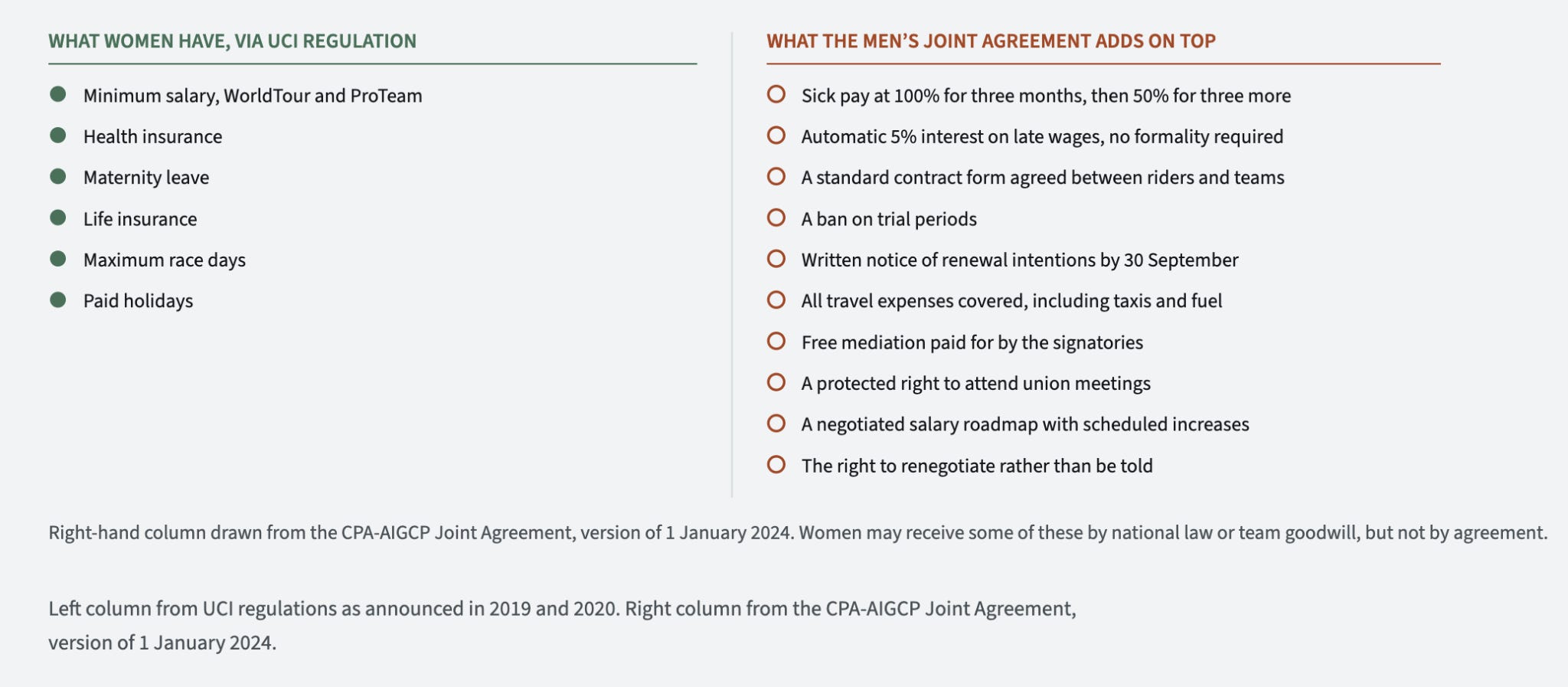
What women have and what they are missing
Below is a quick and non-exhaustive breakdown of what women have secured through UCI regulation and what the men have gained on top through collective bargaining.
What will representation look like in the future?
Right now it seems like we won’t see collective bargaining anytime soon. But with the rise of women’s cycling, there is reason to hope that money quickly becomes a non-issue for better salary floors and added benefits. Collaboration within the CPA and AIGCP between their men’s and women’s divisions could also extend certain articles in the men’s joint agreement to the Women’s WorldTour.
It would also be an ideal outcome if parties like the TCA and UNIO had a seat at the table. That could cause more disagreements and slow negotiations down in a joint agreement, but it could also bring fresher perspectives when advocating for women in the sport. It could also lead to the women’s WorldTour adopting better regulations than the men’s. I have no clue what the right answer is, but hopefully this story will shed light on an important topic that is rarely discussed among fans and even industry professionals.
Ride and rip,
Kyle Dawes

Interesting. Thanks for sharing this Kyle. Joe Laverick and I have a story coming out today about WWT.