


Some of the most interesting topics I cover on this newsletter are financial analysis and brand strategy deep dives on iconic cycling brands. Sometimes the story is how a brand like Rapha is taking a bold approach to brand development, and other times it is how brands like ENVE and Ventum present compelling acquisition or corporate development opportunities. These stories tend to focus on particular corners of the industry and almost always center on the United States, which is the core thesis of Built on Bikes.
More recently I have explored broader analysis, including research on the market implications of the Tour de France Femmes Avec Zwift. While that piece shifted focus to the WorldTour, its core purpose remained the same: growing the sport in non-European markets and engaging more financial backers and fans. This week is another exercise in analyzing the upper levels of road racing to understand current market dynamics and identify ways to attract better financial support for the sport.
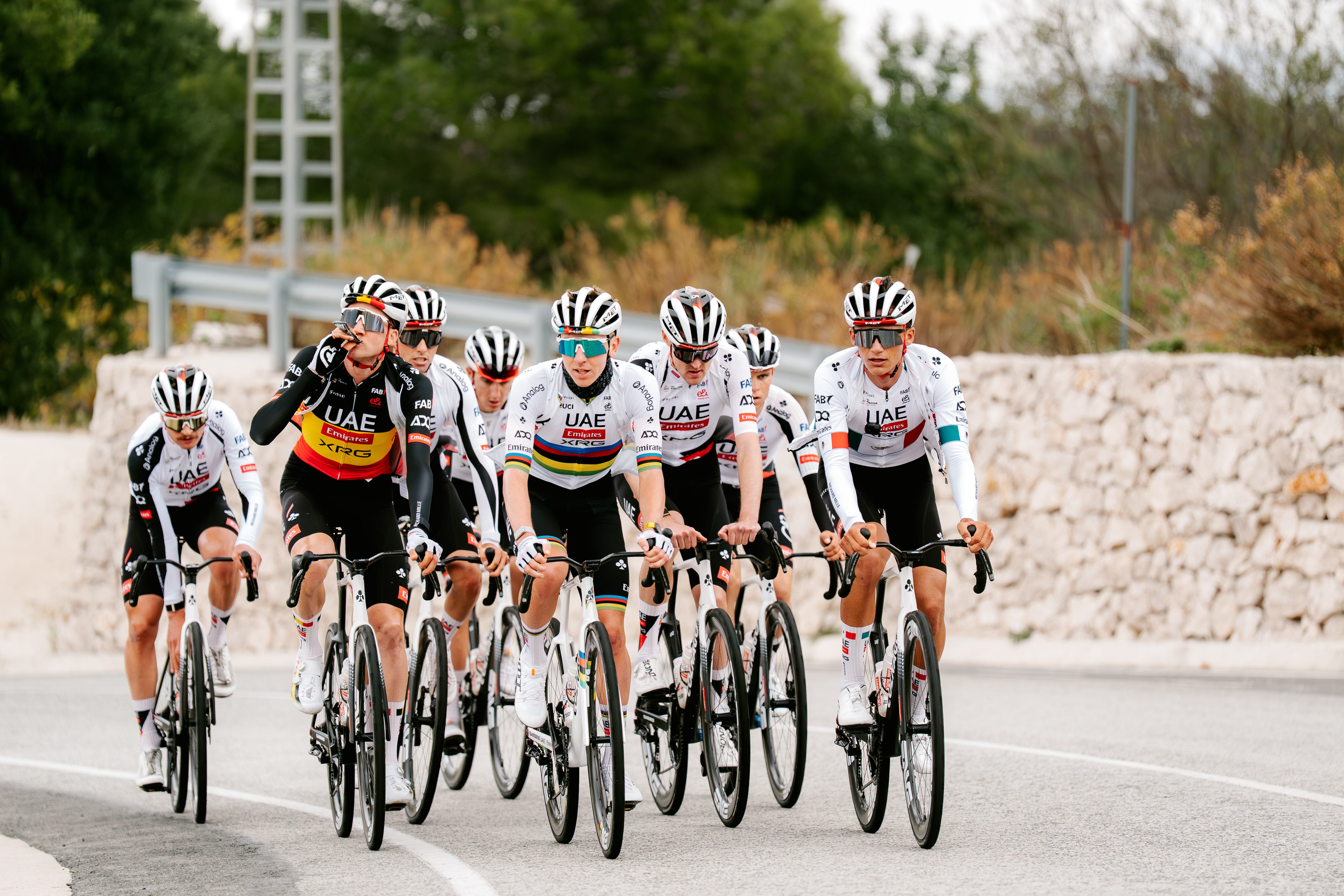
There are currently 55 teams competing across the Pro Continental and WorldTour levels of both men’s and women’s cycling. Between them there are over 173 sponsorship positions at the title and primary sponsor levels. It is not a stretch to say the majority of these sponsors are not particularly well known outside of cycling. These sponsors certainly receive value from their team affiliations, but their overall impact on the sport is limited by the scale of their financial output. Grocery stores, flooring companies, and postal providers do not exactly signal financial prosperity in an era defined by tech and AI.
This week is a deep dive into the current sponsorship landscape of professional cycling. It will look at what types of businesses currently influence the sport, the financial implications of those sponsorships, and the market dynamics they create. It’s possible to have a future where professional cycling teams attract more tech-forward sponsors with deeper pockets, but understanding the current reality is the necessary first step toward making that pitch. So how do we get there?
Analysis methodology
There is a lot of ground to cover across 55 WorldTour and Pro Continental teams, so I was selective about which sponsors to include in the analysis. The main criteria fell into two buckets: influence and industry. The goal is to focus on sponsors with the most financial impact on a team and operate outside the cycling industry. With that in mind, the selection criteria varies between WorldTour and Pro Continental teams.
*The only cycling brands included in this analysis are those that serve as title sponsors, such as Lidl-Trek and Canyon-SRAM.
WorldTour
For all men’s and women’s WorldTour teams I selected all title sponsors and up to three non-cycling industry primary sponsors. WorldTour is the pinnacle of the sport and primary sponsors at this level can also contribute significantly to a team’s budget, so the inclusion criteria is relatively broad.
Pro Continental
Pro Continental teams have the ability to compete in select WorldTour events, meaning their sponsors can occasionally access the same benefits as WorldTour-level sponsors. These teams therefore attract more meaningful backing from outside brands, which warranted their inclusion in the dataset. That said, the drop-off in financial contribution and influence between title sponsors and primary sponsors is more pronounced at this level. For that reason, only title sponsors from Pro Continental teams are included in the analysis.
Timeframe
This analysis is a snapshot of the current professional cycling sponsor landscape, limited to 2026 sponsors. Understanding historic trends in cycling sponsorship would add value, but conducting that analysis reliably is beyond the resources of a solo author and researcher. The current snapshot is still worth examining on its own terms because it reveals the existing strengths and weaknesses of the system.
What are we trying to understand?
The primary goal is to understand where the bulk of money in professional cycling currently comes from, identify the strengths and weaknesses of the existing sponsorship model, define what makes a good sponsor, and use that knowledge to engage better sponsors that will modernize the sport and ultimately bring more capital into its development.
As we work through the sponsorship data the goal is to start with the basics, identify surface-level trends, and then go deeper into the more interesting findings before zooming out to think about what the future of professional cycling sponsorship could look like.
The raw data
Geographical composition
The most basic question we can ask is where sponsorship money comes from and who is behind it. As expected, Europe leads with 72.4% of sponsors headquartered there. Asia represents 14.9%, though the breakdown skews heavily toward Gulf states, with 14 sponsors from countries like UAE, Saudi Arabia, and Bahrain compared to only five from East Asian countries like China and Japan. North America accounts for just 9% of sponsors, with the remaining roughly 4% split between South Africa and Australia.
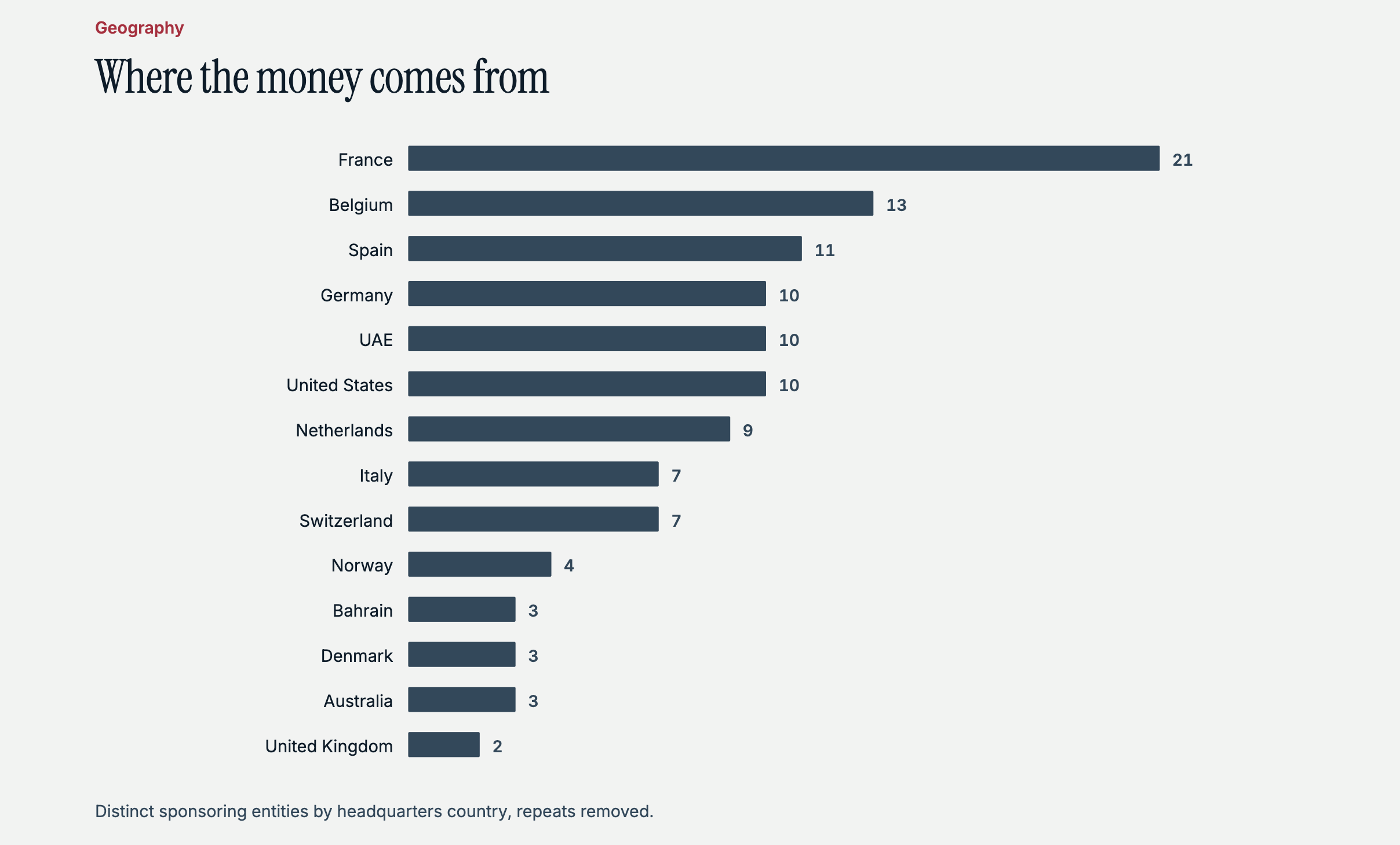
Key geographical takeaways:
Gulf states punch well above their weight, with UAE alone accounting for 10 sponsoring entities
France leads all individual countries with 21 sponsoring entities, followed by Belgium with 13
Latin America and Africa have virtually no representation
Industry composition
Across the 55 teams, the industries that sponsors operate in varies greatly, but some clear groupings emerge across the pelotons.
Financial and insurance institutions: Stifel, Rabobank, Caja Rural, Groupama, AG Insurance
Grocery and discount retail: Lidl, Intermarché, Jumbo, Rema 1000, Picnic, Decathlon
Energy and utilities: Total Energies, Ineos, Uno-X, Bapco, XRG, Suez, Burpellet
Technology: Visma, ServiceNow, Netcompany, Webex, Mistral AI, Protime
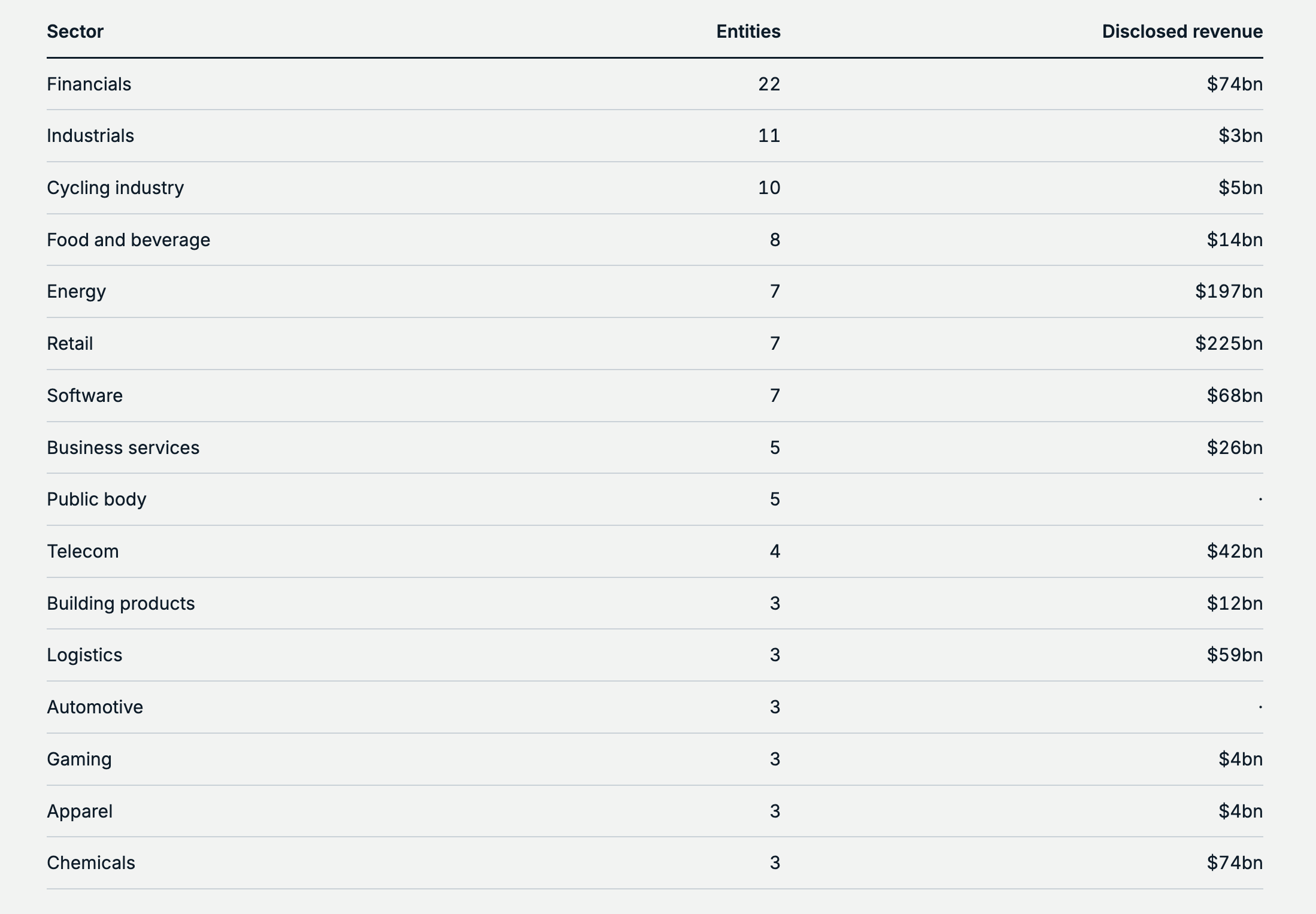
Financial institutions represent the largest portion of sponsors, followed by industrial companies, cycling title sponsors, and a broad range of consumer brands. Technology companies have only recently emerged as a sponsorship category within the peloton, but it is clear that teams now actively seek technology partners, particularly those that can directly impact team performance.
The surface-level findings
Concentrated funding
One of the first things you will notice when looking at professional cycling sponsors is that the number of truly unique funders is smaller than the total sponsor count suggests. The reason comes down to multiple individual sponsors belonging to three distinct clusters where money ultimately traces back to a single entity: families, sovereign states, and conglomerates.
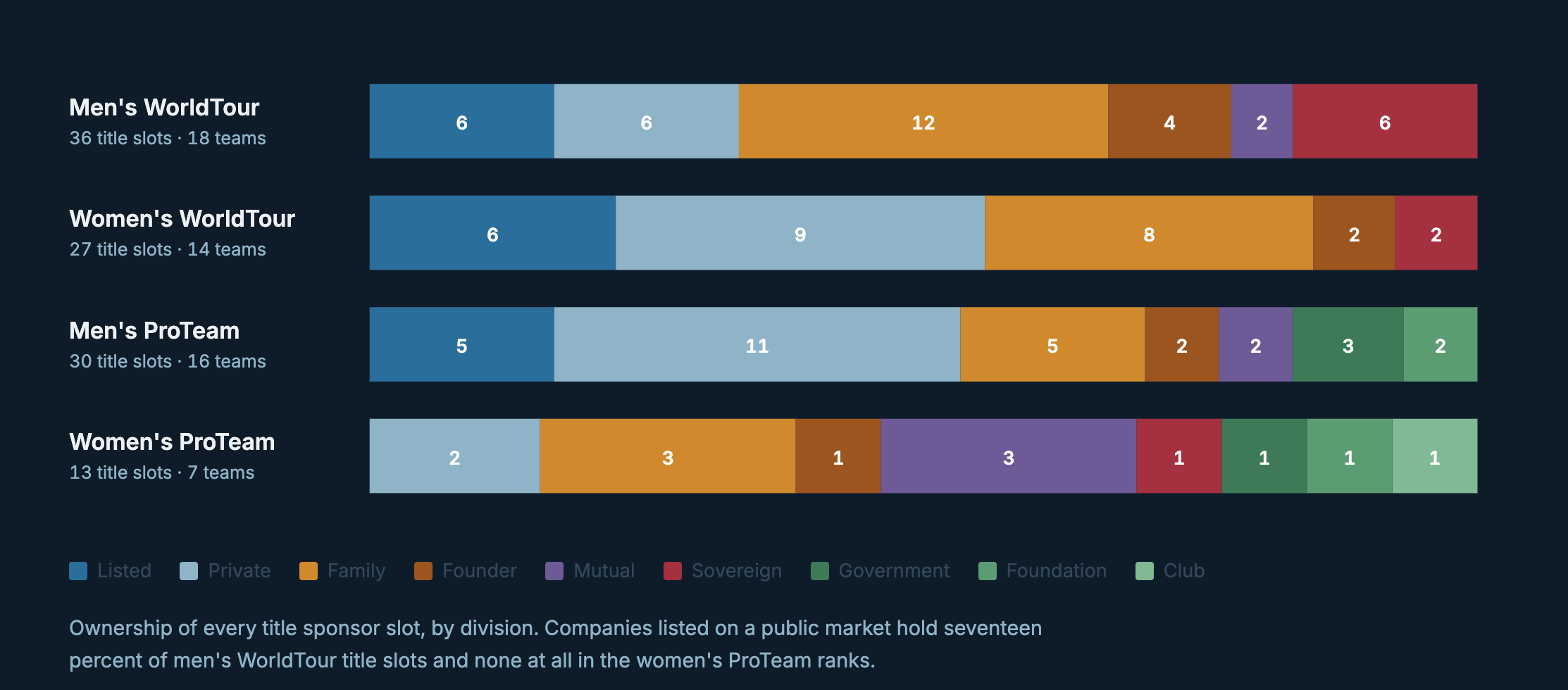
Within the WorldTour, two multi-entity families control a significant portion of funding across two teams. The Norwegian Reitan family controls Uno-X and Rema 1000, and the Australian Ryan family owns Jayco, Mitchelton, and Let’s Go. Within Jayco Alula and Uno-X, funding is effectively controlled by one wealthy family with a passion for cycling and a clear interest in sports marketing. This is not a new concept and ties directly to a recurring theme on Built on Bikes: wealthy individuals with a genuine personal interest in the sport are exactly the kind of backers we should be actively pursuing.
Perhaps the most dominant cluster in professional cycling is the proliferation of state-backed enterprises and sovereign wealth funds. This is not a new topic and has been covered at length by major cycling publications in the context of sportwashing and financial inequality among professional teams. The most prominent examples center on the United Arab Emirates, which has direct ties to numerous sponsors including XRG, G42, First Abu Dhabi Bank, L’IMAD, NMDC Group, and Emirates. Saudi Arabia has direct links to AlUla, Bahrain influences Bapco Energies, Mumtalakat, and Beyon. Other state-backed sponsors include FDJ United, where France holds a minority stake, Kazakhstan through Astana and Samruk-Kazyna, and Belgium through its national lottery, Lotto.
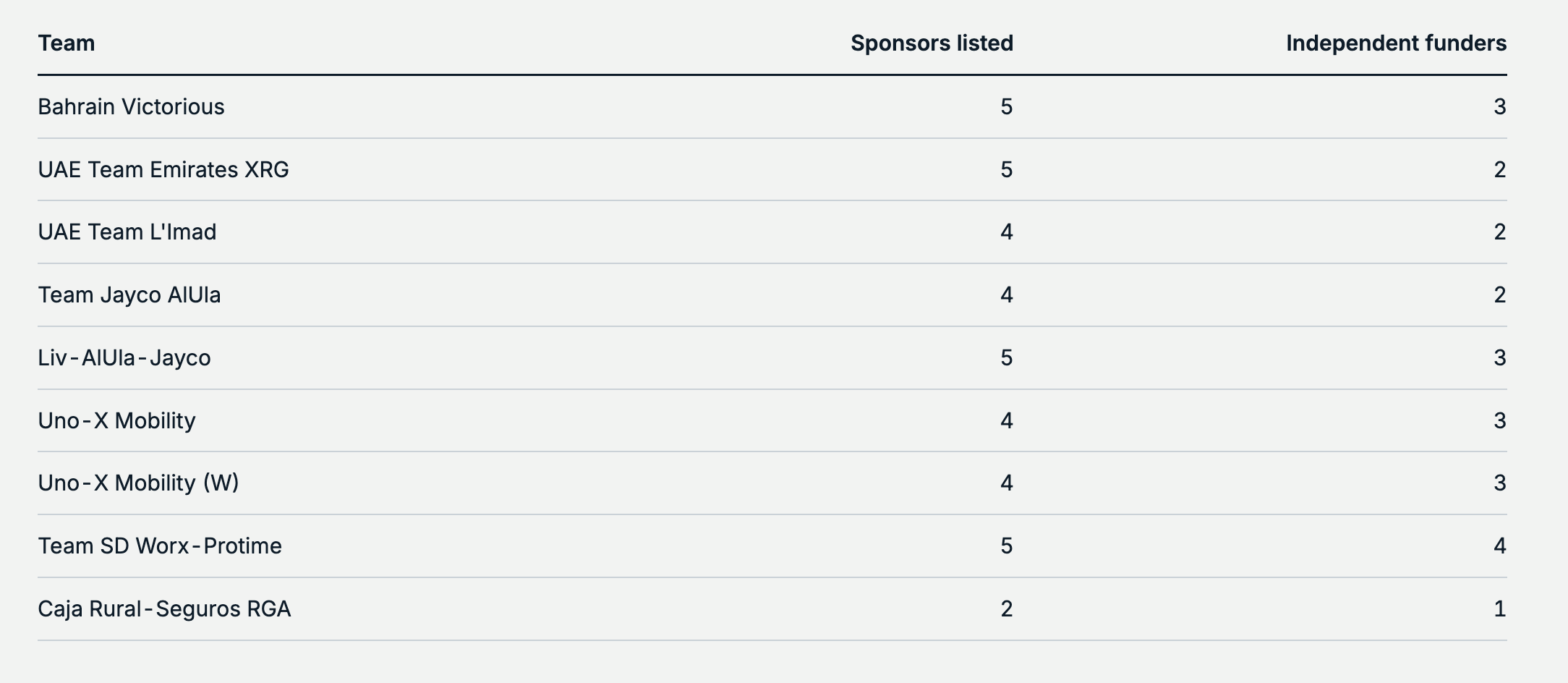
Finally, conglomerates play the biggest role within French teams, with FDJ United controlling Unibet through acquisition and Groupama owning Plus Gan.
Little transparency on funding - who signs the check
Valuing the sponsors of professional cycling is nearly impossible because the vast majority of companies represented are not publicly traded. There is nothing wrong with that, but it does make it difficult to quantify what professional cycling actually delivers to these companies financially. The breakdown between public and private sponsors does tell us something meaningful about the types of businesses that sponsor cycling, particularly across the different tiers of the sport. The following are the percentages of sponsors with no publicly available revenue figures, broken down by tier.
Men’s WorldTour: 36%
Women’s WorldTour: 43%
Men’s Pro Continental: 90%
Women’s Pro Continental: 77%
The drop-off between WorldTour and Pro Continental is steep. Almost no Pro Continental sponsors publish financial information, while the majority of WorldTour sponsors do to some degree. The difference comes down to how businesses justify a sponsorship as a marketing expense. Public companies have shareholders to answer to and any major marketing decision falls on the CMO to defend. Private companies may only need sign-off from their founder, especially when the founder is the one driving the sponsorship in the first place.
This explains the breakdown fairly cleanly. WorldTour teams are established organizations with years of financial return data and dedicated resources to help justify the expense for public companies. Sponsoring a Pro Continental team is far less expensive and generates less short-term visibility, making it harder to justify through a formal approval process. When a founder is the only sign-off needed, the bar for justification is simply lower.
That is actually a problem. It means sponsorship at the Pro Continental and Continental levels is still too difficult to justify through conventional channels. Both divisions are essential to the development and growth of the sport, and finding better financial backers at this level of the pyramid needs to be part of the solution.
The WorldTour has large backers with relatively low commitment
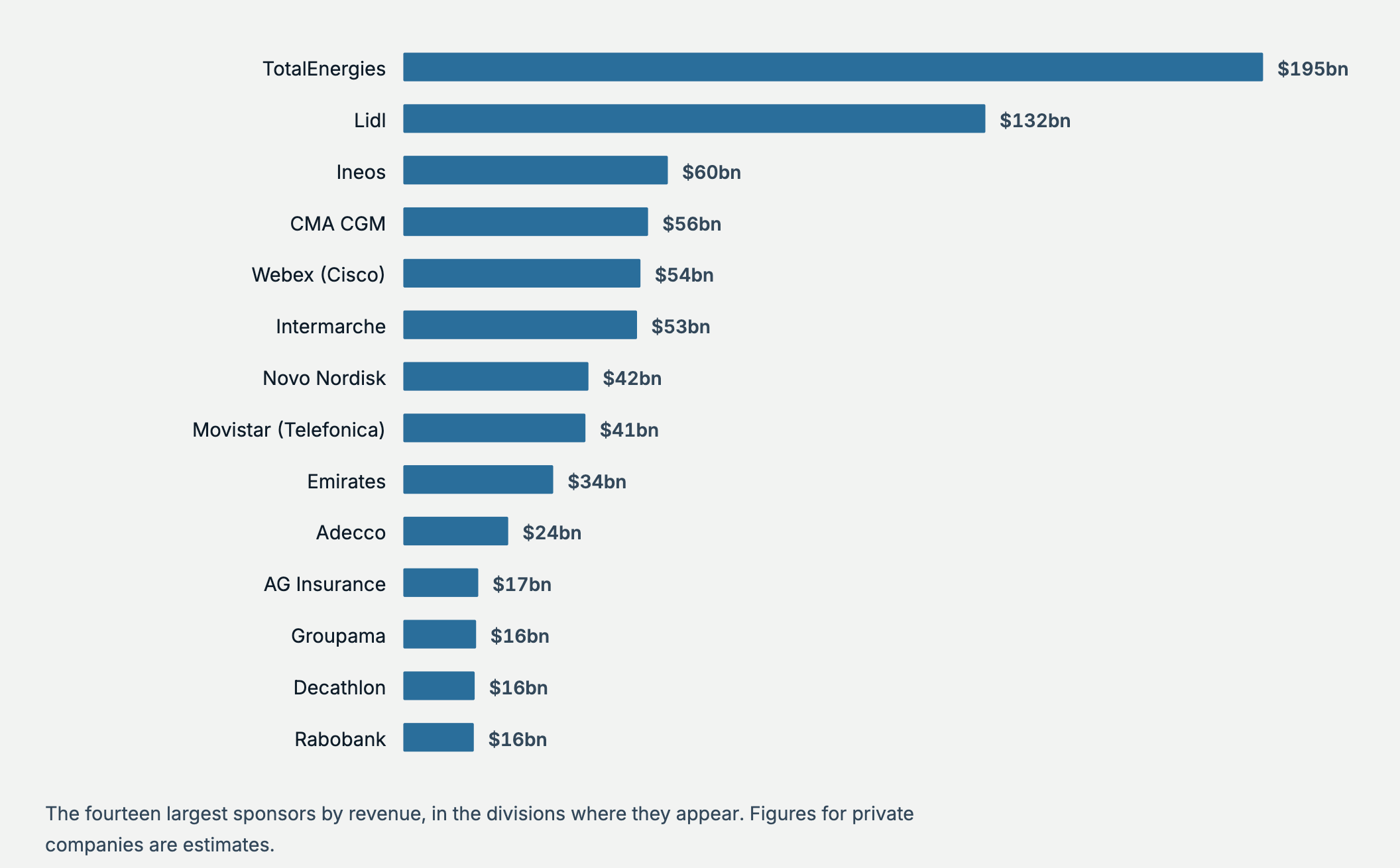
Looking at the highest earning organizations sponsoring WorldTour teams, it is clear the sport can attract major sponsors, but the spread of earnings and distribution of capital across teams varies considerably. Below are the top sponsoring entities at the WorldTour and Pro Continental levels ranked by revenue. The distribution is heavily top-weighted, though more revenue does not automatically translate to more money for a team.
Digging deeper - the edge cases
The surface-level findings give us useful context for thinking about the future of professional cycling sponsorship, but a few data points deserve a closer look. Each focuses on individual teams and their unique sponsor dynamics. These teams may not be the most decorated in their respective pelotons, but each reveals something meaningful about the world of cycling sponsorship, whether it is a structural weakness or an original approach to financial backing.
Ma Petite Entreprise

Admittedly I did not know much about this women’s Pro Continental team before researching this article, but now that I do I am genuinely fascinated. Entrepreneurship is the defining ethos of this team and they represent it authentically. The team operates on an open sponsorship model with crowdsourced backing, meaning any business can become a tiered sponsor based on their financial commitment. The team already has 708 official partners and recently earned their place at the Tour de France Femmes. This team proves that massive corporate entities are not a requirement for success and that virtually any business can find value in sponsoring a cycling team.
Team Novo Nordisk
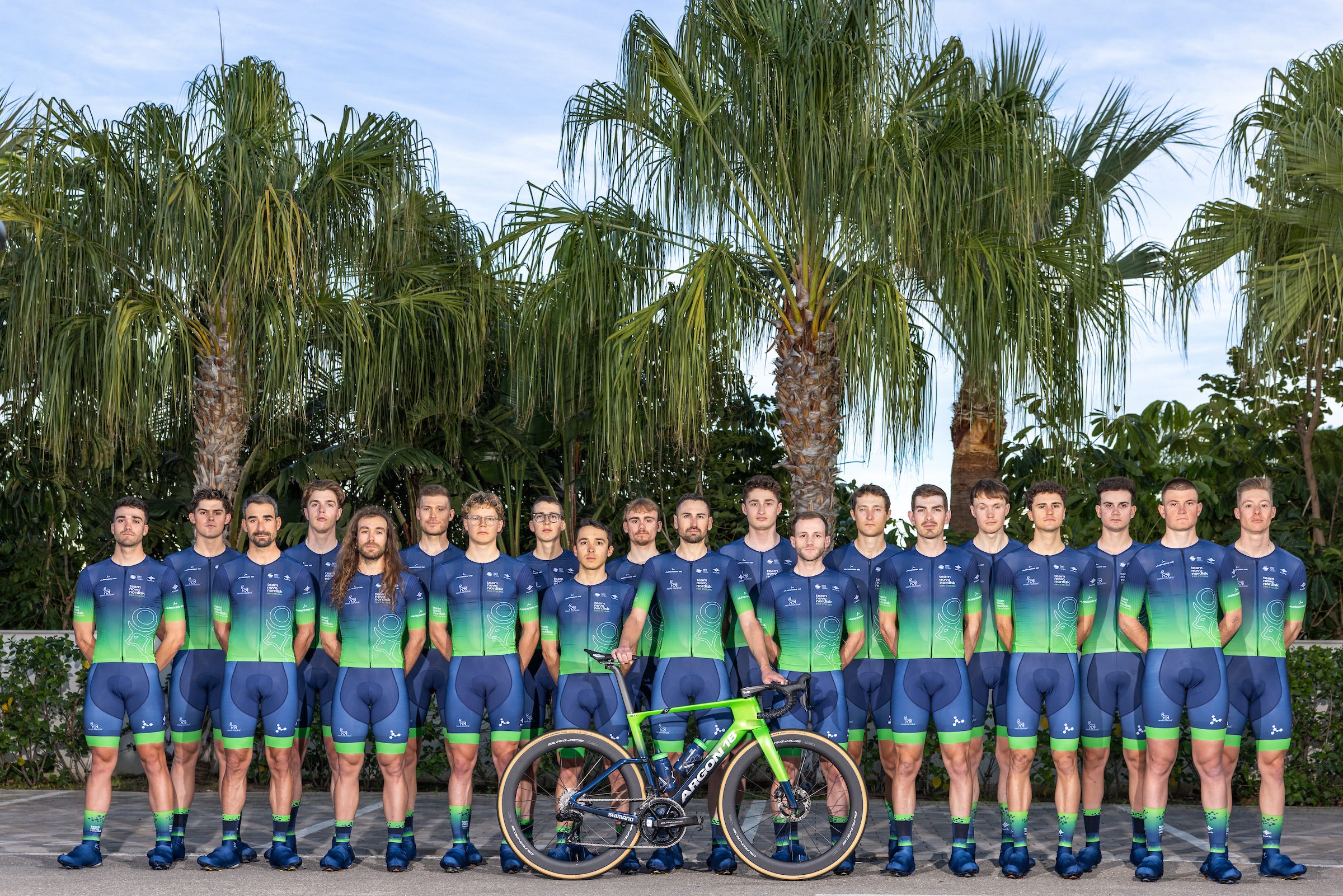
Team Novo Nordisk is the one Pro Continental team with a truly major enterprise title sponsor, and the relationship works on entirely different terms than a conventional sponsorship. For Novo Nordisk this is not about direct financial return, it is a proof of concept. The team’s roster is made up of riders with diabetes, making the sponsorship a demonstration of what the company’s products make possible for athletes managing the condition. Novo Nordisk receives brand trust and product validation in return. It raises a useful question: what other companies could benefit from a similarly mission-driven approach?
FDJ

FDJ fields a successful program, but it also illustrates a risk that affects teams across the professional cycling landscape. FDJ alone is the title sponsor of three teams: their men’s and women’s WorldTour squads and Unibet-Rose Rockets. With the Rockets’ recent success it seems likely they will join the WorldTour before long, meaning one entity would control title sponsorship across three premier teams. FDJ has state ties which reduce the risk of financial failure, but the risk of them exiting cycling altogether remains, and if that happened three teams would lose significant backing simultaneously. It is a clear argument for why cycling needs to diversify its sponsor base.
The takeaways
The goal of this exercise is to identify an ideal sponsor profile for every level of professional cycling that expands the field of potential sponsors and modernizes cycling’s image through the inclusion of more tech-forward title partners. Looking at the current landscape, an attractive sponsor has a brand presence in European markets, is consumer-focused, faces minimal internal hurdles to securing sponsorship approval, and has some non-financial motivation such as sportswashing, product validation, or professional association with elite athletes.
The criteria for identifying good sponsors does not need to be reinvented, but the pool of organizations we apply it to does need to expand. My hypothesis is that the same criteria can apply to a much broader set of companies than grocery outlets, industrial firms, and state-run enterprises, which tend to register as dull to the average consumer regardless of where they are watching. With that in mind, it is time for one of my favorite exercises: getting entrepreneurial and throwing ideas into the conversation that nobody asked for.
Before diving into specific ideas, two caveats are worth noting. While compiling data for this article I conducted an interview for a future piece with a marketing executive from a mid-sized startup that had sponsored a premier endurance event. They noted that a reasonable allocation for that sponsorship was roughly 10% of their total marketing budget. The second caveat is that the example sponsorships discussed here will focus exclusively on privately held technology companies, similar to the one I spoke with. If the goal is to modernize sponsorship within the professional pelotons, this feels like the most logical starting point.
A tech-forward peloton
If you follow the venture capital landscape at all, you will know we are living through a period of record fundraises, early-stage check sizes, and elevated valuations. While most of that focus is on AI companies, other consumer tech companies still benefit from the same funding environment. This means there are genuine sponsorship opportunities for teams to pursue, including a host of companies that are US-based and sell globally. The goal is to identify businesses that can reasonably afford a sponsorship, benefit from it financially, and receive meaningful indirect returns in the process. To close out the piece, we will identify an example tech sponsor for every level of competition covered in this article.
Women’s WorldTour - Maven Clinic
If I were hired as a consultant to advise a WorldTour team on sponsorship strategy, this is the partnership I would present without hesitation. It is an opportunity that feels almost too obvious once you see it, and it makes complete sense if the goal is to reach new consumers and grow the fanbase.
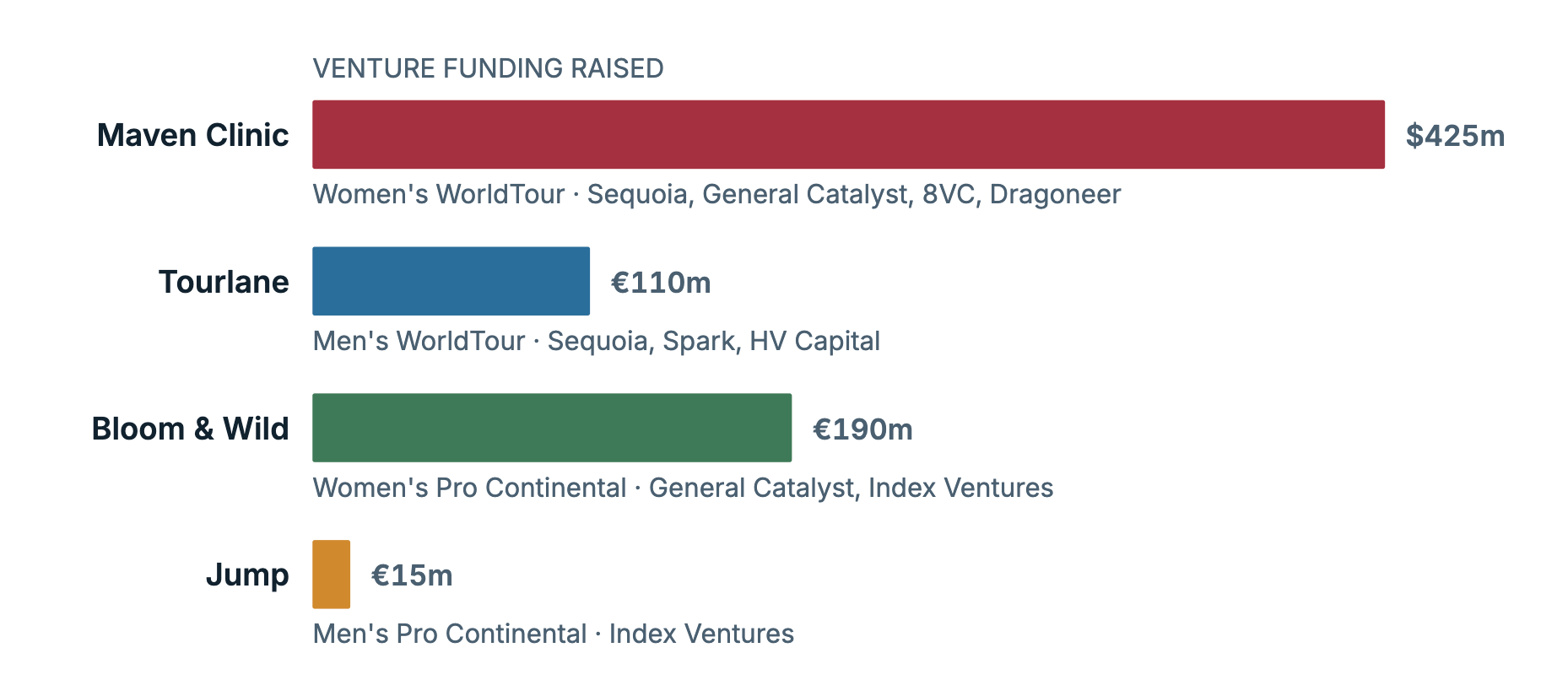
Maven is the largest virtual clinic for women and family health, providing holistic care across a range of services. The company has raised over $425 million in venture funding from leading firms including Sequoia, General Catalyst, 8VC, and Dragoneer. The cost of a title sponsorship slot on a Women’s WorldTour team would represent a modest line item for a company at this scale, but the value of the affiliation would be substantial for both sides.

Maven is not new to sports sponsorship, with existing ties to the NWSL, but partnering with a premier Women’s WorldTour team would be a significant step toward reaching international audiences. We know that women’s sports are exceptionally effective at engaging consumers, and we know that the Tour de France Femmes is one of the premier events in women’s sport globally. Maven’s mission is to provide better healthcare to women and families, and affiliation with elite endurance athletes would go a long way in building consumer trust, credibility, and willingness to engage with their services.
Such a sponsorship would also represent a meaningful moment for women’s cycling. A leading female-founded startup backed by investors who have funded companies like Apple, Airbnb, and NVIDIA would bring a new level of visibility to an already rapidly growing division of the sport. There is a longer version of this pitch that deserves its own piece, but the core argument is straightforward: this sponsorship makes sense for Maven, it makes sense for women’s cycling, and it is hard to understand why it has not happened yet.
Men’s WorldTour - Tourlane
Displacing the established partners of top men’s WorldTour teams is unlikely, but in the middle of the field there is a real opportunity for a new sponsor to enter the sport and modernize the image of a competitive program. This company may not land a title sponsor slot, but it could make a strong case as a co-title sponsor.
German company Tourlane connects travelers with handpicked travel experts to organize customized, authentic experiences. The company has raised over €110 million from investors including Sequoia Capital, Spark Capital, HV Capital, and Airbnb co-founder Nathan Blecharczyk, making it a well-backed European startup with genuine growth momentum.

Given the nature of their product, Tourlane’s consumer audience skews toward wealthier individuals, a demographic that is well represented among cycling fans in both the United States and Europe. Travel companies acting as team sponsors are not without precedent in professional cycling, with newer Pro Continental sponsor Modern Adventure being a recent example. Tourlane has the opportunity to reach a broader consumer audience and collaborate with a team to create elevated training camp experiences that feed directly into team media and marketing content. It may not be as immediately striking as the Maven pitch, but the underlying logic is just as sound.
Women’s Pro Continental - Bloom & Wild
The consumer demographic angle is a factor in the marketing potential here, but it was not the sole reason for this pick. As we have already seen, the drop-off in sponsor profile and funding potential between WorldTour and Pro Continental is steep, but that creates an opening for sponsors to get more value for their investment.
Bloom and Wild uses technology, AI, supply chain innovation, and product design to make sending and receiving flowers a genuinely better experience for both parties. The company serves prominent European markets and has raised over €190 million in venture funding from firms including General Catalyst and Index Ventures. A title sponsorship on a Women’s Pro Continental team would almost certainly represent less than 10% of their marketing budget while meaningfully improving the team’s financial backing.

If Bloom and Wild took the EF approach and collaborated with a team to create a striking floral kit design, it could put a previously unknown team in front of a much larger audience almost overnight. As with Maven, this one is hard to argue against.
Men’s Pro Continental - Jump
This pitch is not quite ready for the market today, but French startup Jump presents a compelling opportunity worth flagging for the future. Jump is a freelance umbrella and payroll company that aims to make freelancing more accessible and practical. The company has raised around €15 million to date, but with Index Ventures on their cap table the trajectory looks promising.

Once Jump raises its next round, sponsoring a Men’s Pro Continental team could be a meaningful step toward reaching more French consumers. Freelance work is common within the cycling industry, so a brand that positions itself alongside a sport many freelancers already love would have a natural entry point with that audience.
For road cycling, the world is its oyster
A lot of ground has been covered in this piece, but it is clear the sport can be doing far more to identify, pitch, and convert new sponsors that will bring a new wave of legitimacy and investment to cycling. Venture-backed consumer tech startups present a real opportunity to get creative with title sponsorships and turn them into genuine partnerships rather than logo placements. The most compelling potential lies in women’s cycling. Both sponsorship pitches for women’s teams practically wrote themselves, which is itself a signal worth paying attention to. With teams like Ma Petite Entreprise already proving that creativity drives success, it is yet another reminder that cycling should be approaching business opportunities with the same inventiveness it brings to the sport itself rather than defaulting to the status quo.
Ride and rip,
Kyle Dawes

The FDJ concentration risk should worry every team relying on one sponsor: one entity backs three premier teams, so one exit wipes out three programs at once. Ma Petite Entreprise is the smarter model, 708 partners means no single sponsor pulling out sinks the team. Same lesson for any athlete brand chasing one big sponsor instead of building a base, concentration feels efficient until the one check stops coming. The real insight is the approval bar: a founder can greenlight a sponsorship alone, which is why 90% of Pro Continental sponsors are private with no public financials. Does cycling actually want the public companies you're pitching, or does their CMO approval process kill the exact flexibility that let founder-backed sponsors exist in the first place?
More of this type of sponsorship breakdown for cycling needs to be made available to freelancers and street hustlers like myself who have been procuring sponsorship since 1980 we sit back we observe we have questions. We’re a little bit removed. We still have the chops and the passion.