


While planning this piece, its original tone and commentary were going to be the harshest of any Built on Bikes piece I have written. It is on a topic I have thought about for the last year, and it deals with real grievances held by athletes and spectators. The UCI Gravel World Series is a collection of 45 gravel events that represents the UCI’s foray into gravel. While the series is still in its infancy, it has experienced a shaky start, at least with one demographic. Ever since the first Gravel World Championships in 2022, there have been multiple occasions where the professional women’s fields have had to navigate suboptimal racing conditions compared to their male counterparts.
Whether it is having to navigate through amateur men’s fields, receiving no live race coverage, or participating on different courses entirely, there has been a growing feeling of animosity toward the UCI, especially among professionals in the US. Regularly seeing athletes take to social media to voice their complaints meant I adopted a pretty fierce sense of discontent with the series. A year ago I even confronted an official representative for the series and pressed them on the instances of inequality as certain events in the series. At the time my message seemed to fall on deaf ears, or so I thought.
After seeing another instance of women having to navigate potentially dangerous race situations at Sea Otter Europe, the time felt right to address the dynamics that lead to these instances of inequality. Coincidentally, while deciding to engage this topic, I was starting to watch the newest season of the popular sports comedy, Ted Lasso. It is a random connection to make, but watching Ted navigate the inequalities of women’s sport made me realize it would be best to approach this topic with understanding instead of spite. In this piece we will take a look at the facts, the actions the Gravel World Series has taken, and identify practical solutions that ensure equal racing for women and create longevity for the series and gravel cycling as a whole.
A closer look at the UCI Gravel World Series
Most Built on Bikes readers are in the United States, so the predominantly European series may be new to some. The UCI Gravel World Series consists of 45 global gravel events, each of which acts as a qualifier for the UCI Gravel World Championships held every year. Riders that finish in the top 25% of their category receive automatic qualification to the World Championships.
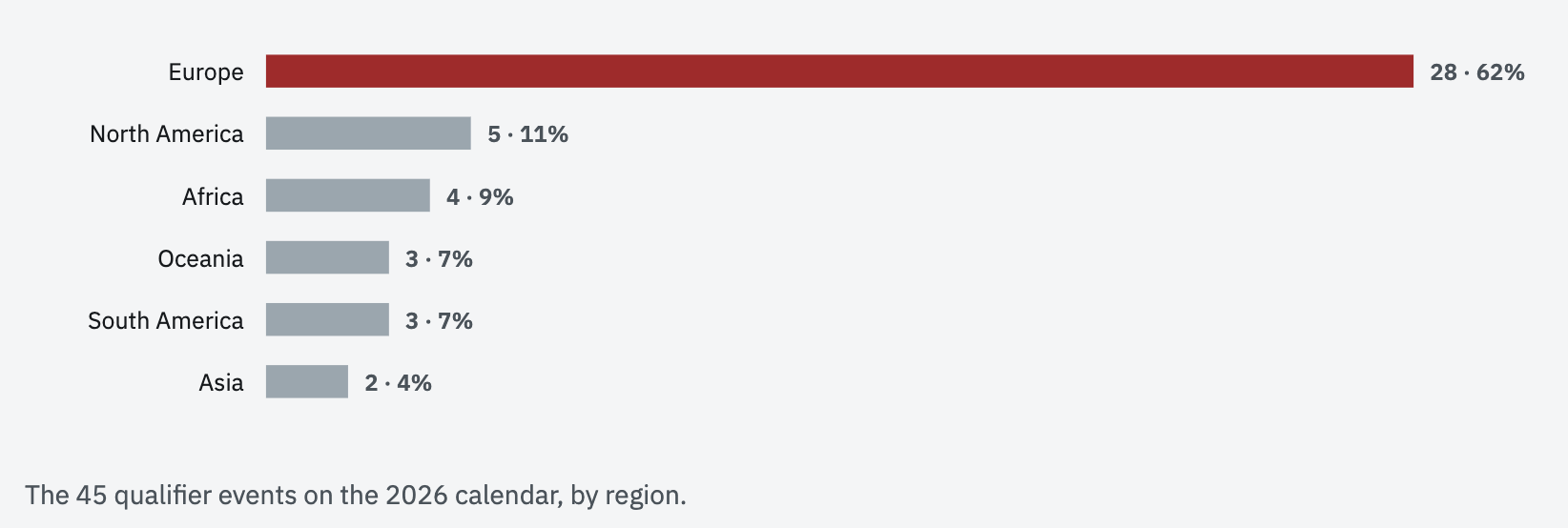
The series has already announced its first six qualifiers for qualifiers in 2027, and it has grown from eleven events at its formation in 2022 to 45 today. Europe hosts 28 of them, representing 62% of the series’ races, while all other continents host only two to five events each. This dynamic is important because most of the incidents we will discuss happen at European events. While the series is relatively new, in many ways it has become a lens into how the UCI might codify and regulate gravel if the discipline reached the same prominence as road and mountain biking.
Does the UCI really govern the series?
The Gravel World Series’ association with the UCI already places the series on its back foot. If you ask cyclists for their opinions on the UCI you will almost always hear frustration and discontent. The UCI has gained a reputation for focusing on non-issues within the sport and ignoring real threats to safety and competition. In the past the governing body has focused on trivial subjects like sock height and handlebar width instead of addressing problems that have led to serious injuries and even death in competition.
On women’s cycling, the perception becomes even worse. Rules and regulations, like handlebar width, have been enforced in the men’s peloton with the women’s peloton treated as an afterthought. Women’s competition is hindered as a result, leading to the UCI being seen as an “old boys club.”
With this reputation, having the UCI brand attached to any series draws an increased level of scrutiny. When athletes and fans see inequality and poor race organization in the Gravel World Series, it becomes easy to associate every shortcoming with the UCI. That association makes it easy to become dismissive of the series and lose hope that any action will be taken to solve the problem. But is the UCI really behind every issue facing the series?
As I found out, the answer is no. While the UCI officially sanctions the series, the organization that actually oversees its rules, regulations, and marketing is a Belgian company, Golazo Sports. In 2011 the UCI partnered with Golazo to create the UCI Gran Fondo World Series, and in 2025 the UCI extended their arrangement for the Gravel World Series until 2030. The real question is which issues rest with the race organizers, which with Golazo, and which with the UCI?
What does Golazo Sports oversee?
After some conversations with reliable sources and my own digging, I found that Golazo distributes detailed rules and regulations to race organizers, provides limited marketing support, and verifies branding compliance before events.
The rules and regulations of a UCI gravel event can be found in full on Golazo’s website. What is decided by Golazo and the UCI, and what is left to race organizers, roughly breaks down as follows.
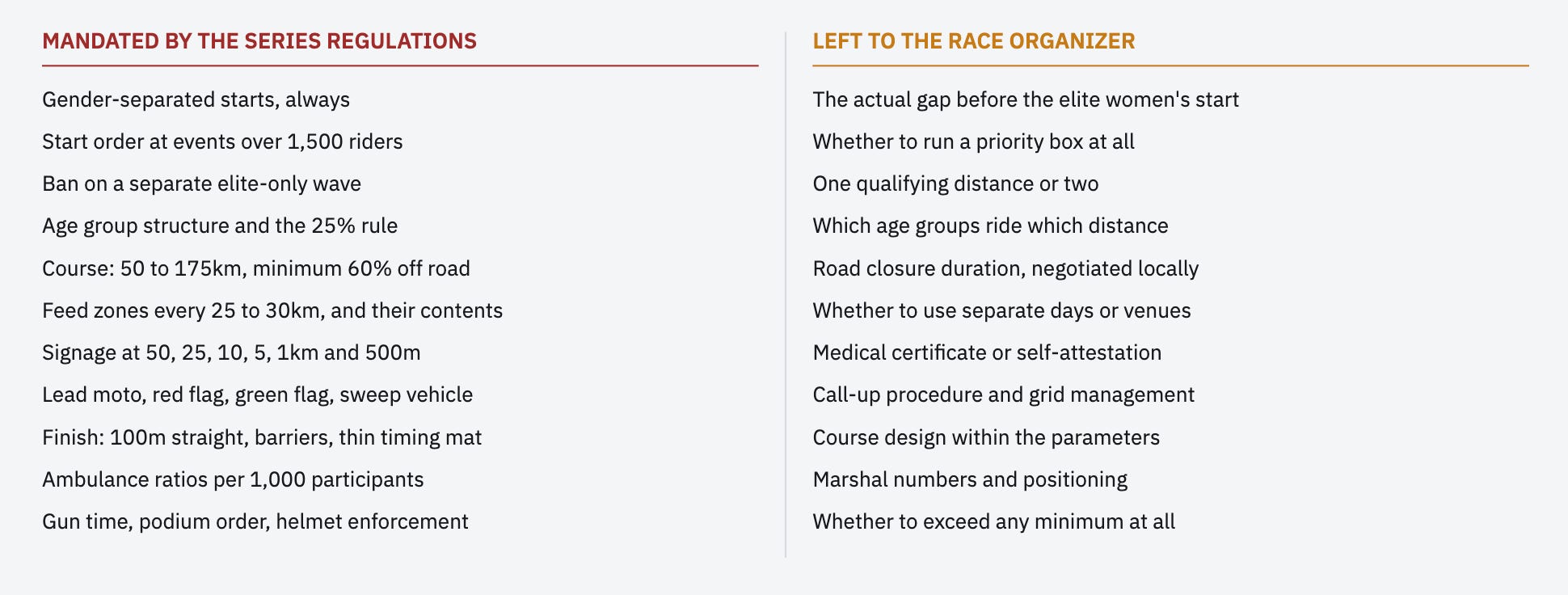
So far this structure seems pretty standard compared with other UCI races in other disciplines. The biggest difference being Golazo acting as middle man between the UCI and the race organizer. The reality we are left with is a double-edged sword. On one hand, riders can be shielded from nonsensical bike and equipment regulations, but on the other, an organization operating on a different scale than the UCI is responsible for spotting shortcomings and implementing changes in a timely manner. The UCI is not always timely, but it has the personnel to research comprehensive solutions from season to season, which probably is not the case for an organization like Golzao.
What are the big issues, and who has the power to fix them?
We now have the facts to determine who currently has influence over the factors affecting the race experience of pro women’s fields. Three issues emerge as the most pressing.
When the pro women start
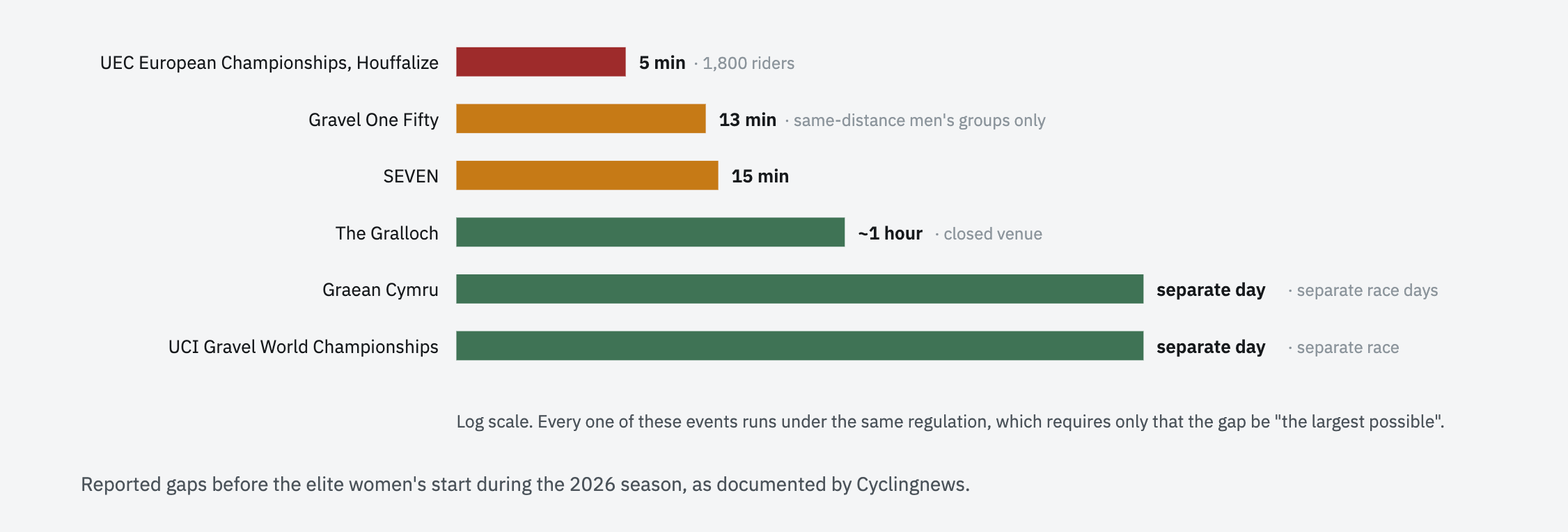
One grievance that has come up time and time again is the dangerous racing created when pro women have to navigate multiple age group fields of amateur men. The issue is not unique to the Gravel World Series, but there are well-documented solutions to it. The most prominent came from Life Time, which prioritized start times for the pro men’s and pro women’s fields. At Life Time Grand Prix events the pro men start first, followed by the pro women’s field, with a time gap of 10 to 30 minutes between the two.
For Gravel World Series events, two parties have influence over these inputs. The first, and most impactful, is Golazo’s regulation that the elite women’s field starts only after every men’s category has set off, including men riding a shorter course. That requirement applies only to events with more than 1,500 riders. Below that threshold, the structure changes, and below 500 riders the detailed procedure is a recommendation rather than a rule.
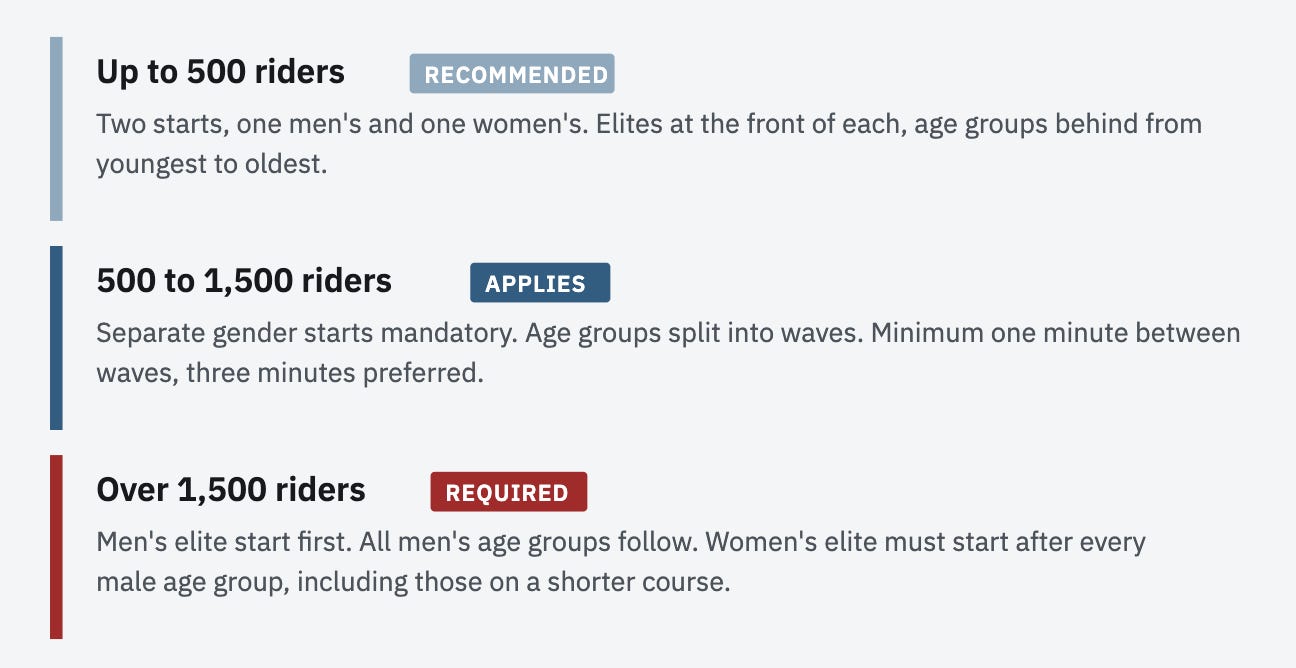
These regulations from Golazo are the crux of the issue, but organizers do have the ability to determine start time staggering, and even whether men’s and women’s races occur on different days.
The first step to fixing the problem might seem obvious, but it is not. Applying a blanket rule that prioritizes and separates pro men’s and pro women’s fields, like the Life Time Grand Prix does, works on paper, but not in reality. The Life Time Grand Prix by design ensures there will be well over twenty riders in both the pro men’s and pro women’s fields. Some Gravel World Series events do not draw the same volume of talent, so there could be events where only five pro women show up to a race.
Golazo representative and Gravel World Series manager, Erwin Vervecken has gone on record saying that in scenarios like this, pro women would prefer starting with a larger group that contains amateur women. This way stronger amateur women can provide some level of race dynamics instead of five athletes waging a war of attrition the entire day. So what is a practical solution?
A nuanced issue requires a nuanced solution. Instead of applying a blanket rule there should be contingencies for races that draw fewer pro women than would be appropriate for a separate pro women’s start.
If the threshold number of pro women is met, an event should prioritize pro fields, with pro men’s and pro women’s fields starting first with at least a 10 minute gap in between.
If the threshold number of pro women is not met, then the current start regulations apply.
I will be the first to admit that this is not a perfect outcome, but it will solve the issue for races that draw the most pro women and demand the highest standards of competition. For races that do not meet the threshold number of pro women, the current arrangement still works best. While it is not ideal for pro women and fast amateur women who will have to navigate amateur fields, those female riders are still the minority of the women participating. Every other age group woman participating would have a better race experience in this system. If a race director staggered the age group starts so that a male age group started, followed by the equivalent female age group, the result would be a far more stressful race dynamic, as women would have to navigate slower male riders in front of them and faster ones behind them.
Lack of live coverage
Let us be clear, lack of coverage is a major issue across all female disciplines and races, including the Tour de France Femmes, but there is usually some sort of women’s coverage. There have been multiple instances where Gravel World Series events have provided coverage of the men’s race, but not the women’s. The most notorious was at the first Gravel World Championships, where there was no live coverage whatsoever of the pro women’s race.
There is no excuse for a lack of coverage for events as big as the World Championships, full stop. But when we look at the structure and resources of other events, the discrepancy in coverage can be attributed to logistical challenges. If pro women are starting behind all men’s age groups, film crews quickly become another obstacle in the women’s race. Navigating film crews buzzing ahead to capture footage while also dodging amateur men could be a recipe for disaster and pose real safety hazards. Even so, we cannot just accept the lack of women’s coverage, especially if the men’s field is receiving coverage at the same time.
After conferring with direct sources, 2026 has allegedly been used as a test year for future broadcasting organized by Golazo. There is no indication that every event in the series will have live coverage next year, or that any coverage will be equal between the men’s and women’s fields. The other caveat is that live coverage will be a packaged event add-on that race organizers would have to purchase from Golazo, something that will not be financially feasible for some events.
Again we are left with a complicated issue and no clear answers, but one fact holds: pro women’s fields need to have equal coverage to men’s fields. Since it appears that Golazo is the entity pushing for and facilitating live coverage, it is on Golazo to ensure that coverage is equal. For races that meet the threshold number of female pros, the goal should be the highest quality broadcasting for both fields. For events with fewer resources, options should be available to present live race updates via social media. As we learned with Leni Carrillo, this approach can be as effective as a polished production.
If an organizer can only afford to cover one field, or if Golazo only has the resources to cover one, then there should be no live broadcast at all. Hopefully social media strategies like the ones we discussed with Leni can avoid that outcome. It would be a major blow to the marketing potential of events and the series, but in my opinion, if a compromise still involves any inequality, then it is not a real solution.
Course length differences
This controversy is one that lives and dies with the race organizer. In the past, multiple pro athletes from the United States have criticized the decision for women’s fields to race shorter distances than the men’s fields. A hallmark of American gravel racing is that pro men and pro women take on the same course. This is an outlier in the world of professional racing, though. It is common practice in Europe for pro women’s fields to race on shorter courses. European pros generally seem to have little issue with this setup in road racing, so it would make sense that European gravel events follow suit.
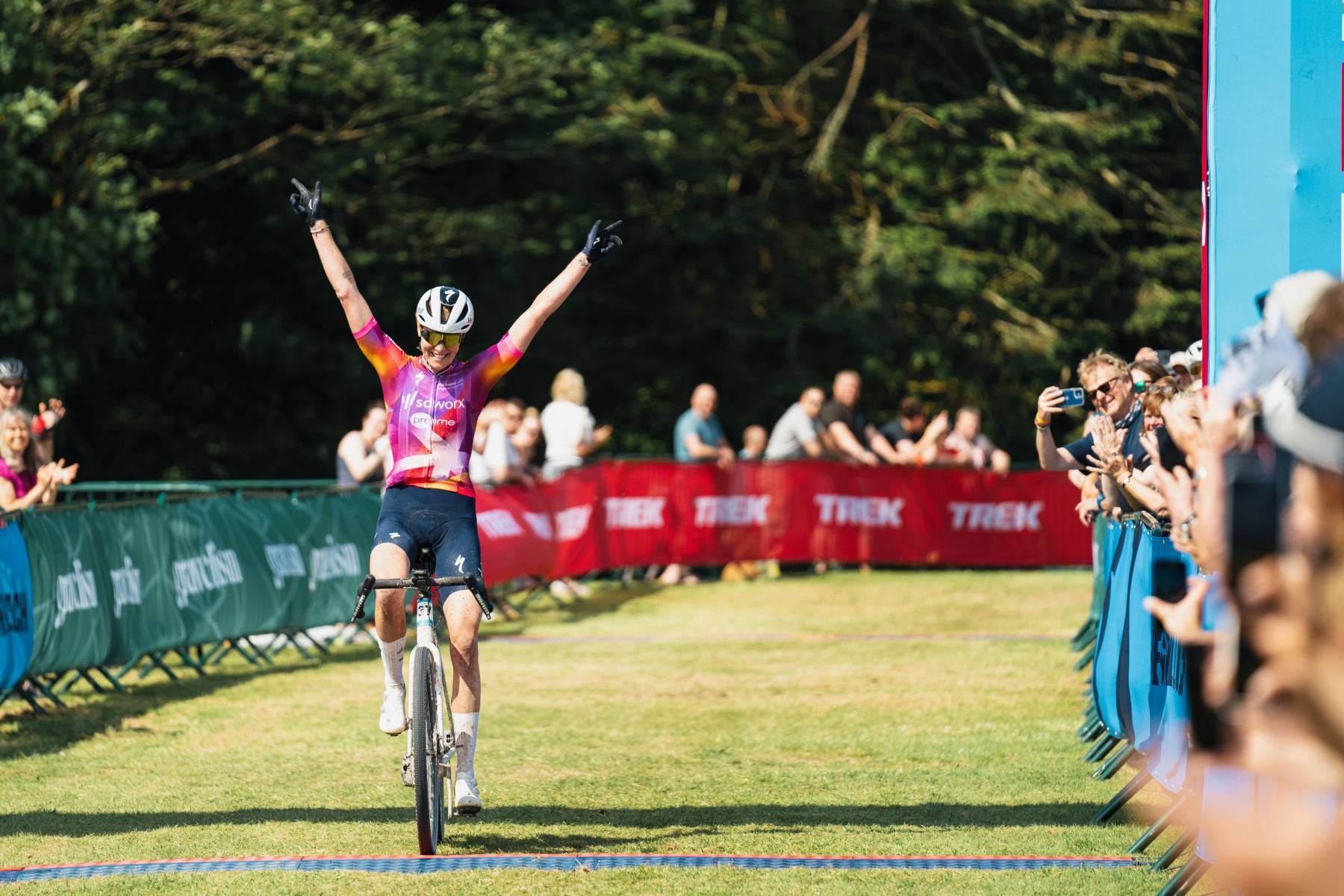
Therefore, I am willing to say this is not actually an issue with the series itself. I respect the discourse that American pros have brought forward, but this seems like a cultural difference and a decision that does not come from the UCI or Golazo, except at World Championships. A solution could be a requirement for certain World Championship events to follow the American standard of equal distance while others adopt separate courses for men’s and women’s fields.
Where this leaves us
After looking at the issues, the logistics, and the parties who control the operations of the Gravel World Series, we are left with a series that possesses great potential. The only thing standing in its way is a list of systemic changes needed to repair brand image and trust with female athletes and fans. The series is fighting an uphill battle given its affiliation with the UCI, but if it can make changes and exploit the benefits of being run by a third party in Golazo, then it could reach the prominence of other series like the Life Time Grand Prix and Gravel Earth.
For those of us who want change enacted, we have the benefit of dealing with an easily reachable entity that has near absolute power to make operational adjustments as it sees fit. The three problems that plague the series and hinder equality are complex, but there are relatively simple actions that could sharply reduce negative experiences for pro women in the series. We have discussed those short-term fixes, but there are still things Golazo could do beyond directly addressing these three issues. My proposed fixes don’t solve everything, so how does Golazo create a culture of continuous improvement?
Creating a culture of excellence
As we have seen, the Gravel World Series is sprawling and scattered across the globe. Cultural differences and the individual liberty granted to race organizers mean there can be large discrepancies in how races are run, presented, and perceived. Allowing organizers to make their race unique is a strength, but the small details that change from event to event can negatively affect pro women’s fields.

Beyond following the Golazo event guidelines, each event essentially operates in its own bubble. Race organizers are not learning from their peers or discovering new efficiencies and event structures that benefit all athletes. Since the number of Gravel World Series organizers is so large, Golazo is well placed to connect them to one another. One thing Golazo could be doing to create a culture of continuous improvement is to build cohorts of event organizers so they can share best practices, discuss the cultural differences that affect the perception of a race, and build a strong sense of community in the series.
Speaking of the series being scattered, I can only assume that the team at Golazo that manages the series is spread thin across 45 events spanning six continents. The UCI has already delegated the bulk of its responsibility to Golazo, so could Golazo distribute responsibility even further? We do not want too many cooks in the kitchen, but hiring employees to act as direct liaisons for geographical subsets of races would create more reliable lines of communication between organizers and Golazo. Hiring someone whose sole focus is equality in racing would also be a significant step forward.
A final note on understanding
The only individual I have named directly in this story is Erwin Vervecken. Right now he is the person at Golazo who acts as the key representative for the series. I will be honest: for a long time I have not had the best perception of Erwin. From sending him a message voicing my concerns about issues affecting the women’s fields to seeing his responses to other athletes who have pressed him on the issue, I thought his receptiveness was lacking.
Since reporting this story, however, I want to give credit where credit is due.. Conversations with people connected to the series who care deeply about the experience of women participating in it revealed a lot. First, communication between Americans and Erwin can expose cultural differences in presenting one’s thoughts. What is normal language for someone from Belgium might come off as dismissive or harsh to Americans who are unfamiliar with that style of communication.
I also was told there is good evidence that Erwin cares deeply about the issues discussed in this story. From requesting feedback directly from race organizers and athletes, to making real rule changes from season to season, he is attempting to bring more equality to the sport. While the decisions have not solved the issues, there is a real desire and intent to do so. I will always push for accountability when a bad decision is made, but for now I thought it was important to bring a little more understanding to the situation, just like Ted Lasso would.
There is a lot of work to be done, but I am hopeful the Gravel World Series can become the third prominent series in the sport alongside the Life Time Grand Prix and Gravel Earth.
In other news
USA! USA! USA!
USA Cycling had one of its most remarkable performances ever this weekend in Montreal. Americans Ashlin Barry and Brandon McNulty were crowned world champions in the U23 and Elite men’s road races. McNulty is the first American to win the elite road race title since Lance Armstrong in 1993. Anyone who reads Built on Bikes knows the work is happening behind the scenes at USA Cycling to make these results possible. Congratulations to the riders and everyone at USA Cycling!
Rapha
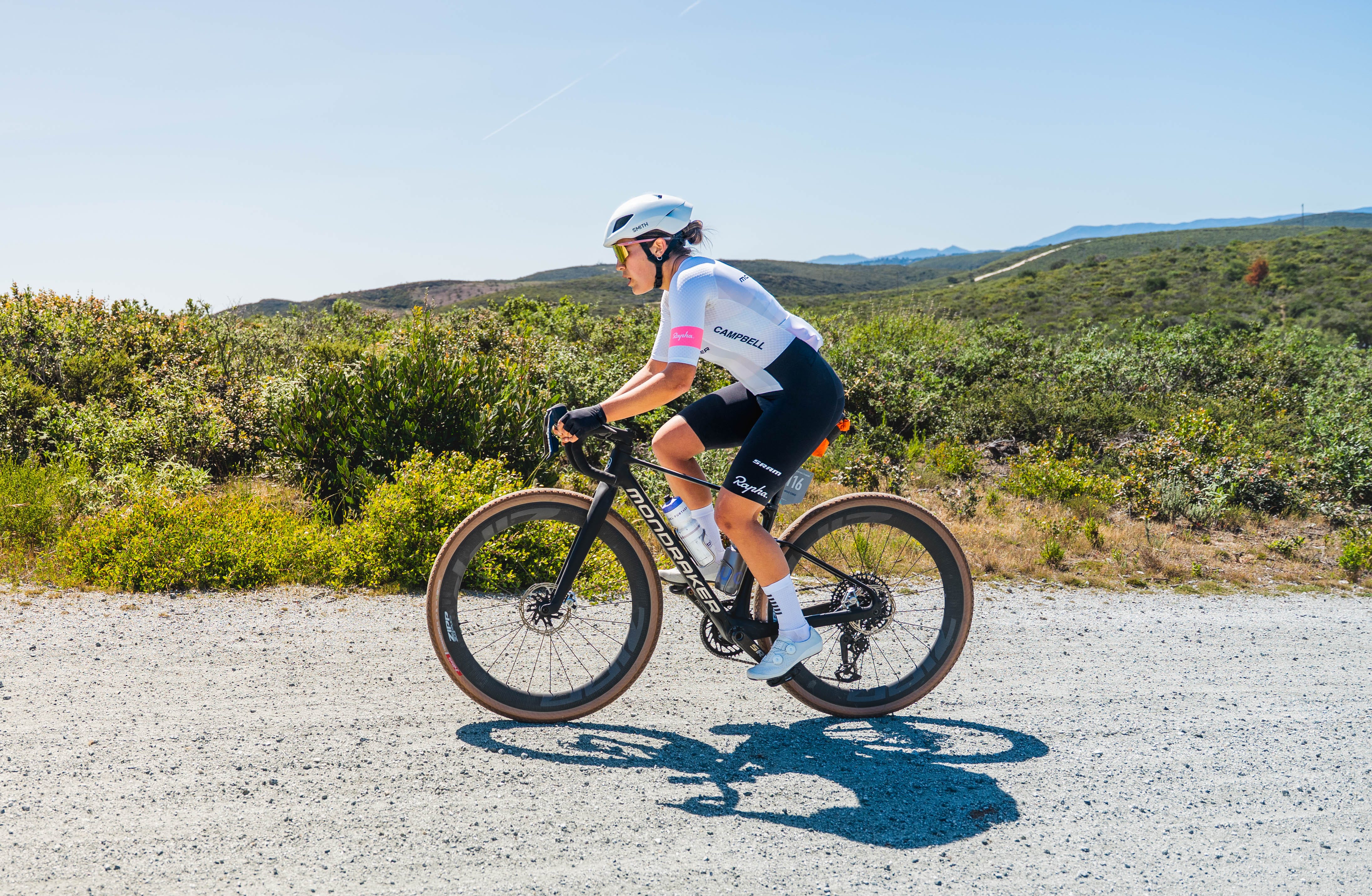
Last week, Rapha CEO Fran Millar announced that she would be stepping down from her position after two years of leading the brand. She said the strategic plan she worked on is well in motion, but the time has come for someone else to lead more aggressive execution. When the news broke, it felt like a generation of Rapha fans-turned-haters piled on, arguing that the brand has done everything wrong in the last nine years. They aren’t wrong that the brand has been in free fall, but I was quick to defend Fran.
In the last two years she has introduced a new strategy that focuses heavily on the American market and bets on American athletes making the sport popular at home. This is a humble brag, but this weekend reinforced that vision. The entire cycling world was just flooded with images of Brandon McNulty crossing the finish line, decked out in his Team USA Rapha kit. Rapha is not down and out. It is on the rise.
Ride and rip,
Kyle Dawes

Nice piece. Regarding course distances, the Cape Epic shortened their women's distances this year to keep similar finish times as the men, and most riders were in favor IIRC.