


Built on Bikes has always had close ties to the world of running, specifically trail running. In one of my earliest stories, we explored the crossover between gravel and trail running events. It is becoming increasingly common for off-road cycling events to add trail running options to increase participation and engagement. Last week, while discussing the overlap between The North Face’s sports marketing catalog and cycling, trail running was brought back to my attention.
While the link between off-road cycling and trail running is clear, the relationship between road cycling and road running remains underdeveloped. By not establishing clear relationships with running, the cycling industry is losing out on easy, low-lift growth opportunities. The reality is that running is outpacing cycling in nearly every metric. We all know that the biggest reason for this is running’s low financial barrier to entry. Still, the running industry has noticed the cycling link and has already begun to benefit from it. Simply put, cycling needs to catch up.
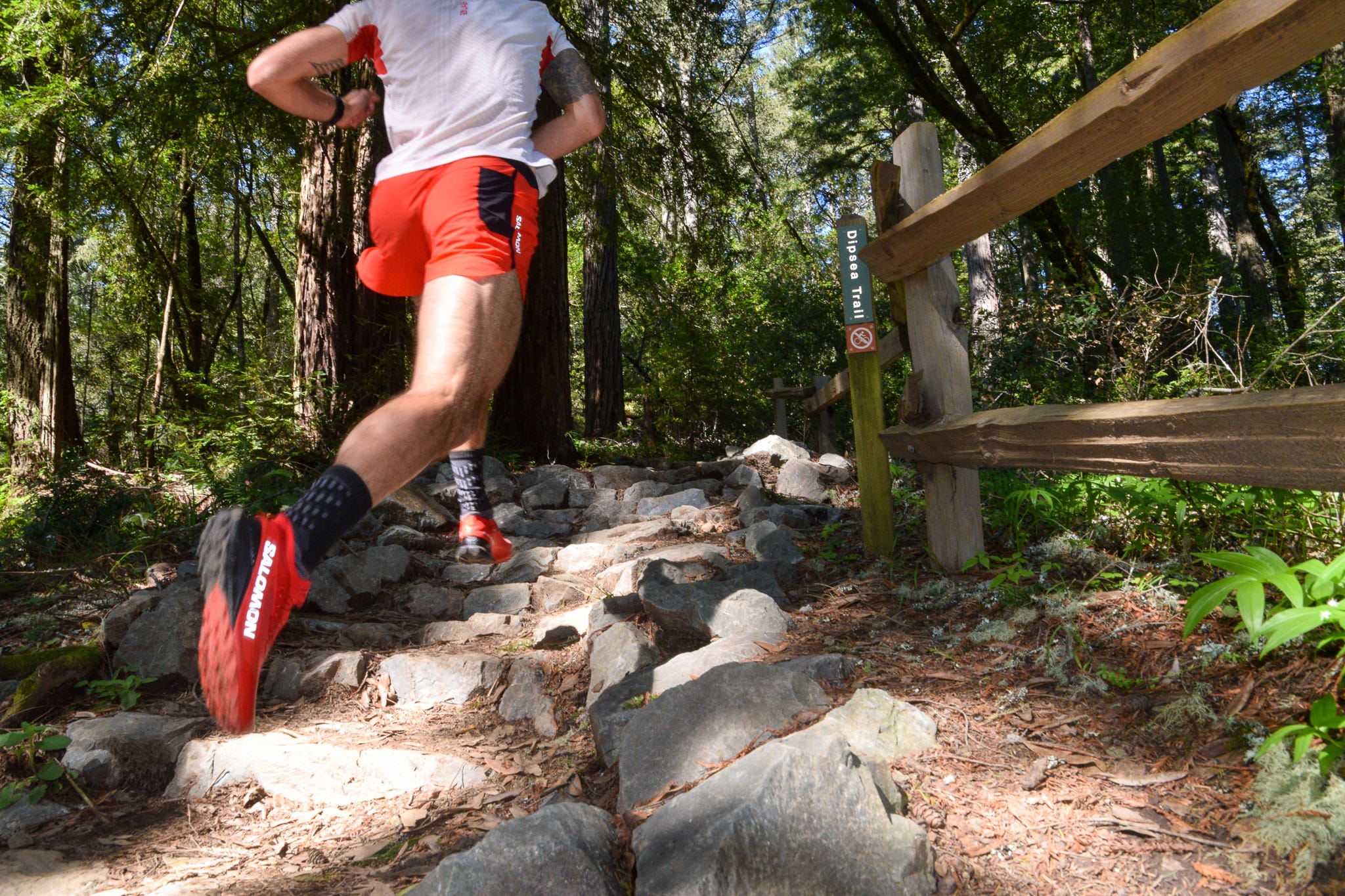
Between trail running and road running, there are numerous avenues cycling brands can take to contribute to and benefit from the running boom. I believe the business case is clear and that there are more than enough signals in the market to justify investment into running synergies. This week we will explore the various market signals, how cycling brands can engage holistically with running’s rise, and how growth can be extracted during times where the cycling industry is struggling in isolation.
Running’s rise by the numbers
There is a plethora of anecdotal evidence demonstrating running’s rising popularity, but looking closely at the industry’s performance reporting confirms that assumption. Analyzing several 2026 reports showed consistent year-over-year growth in the running industry, something that cannot be said for cycling. Six industry reports were aligned on the growth trend.
Race signups are growing
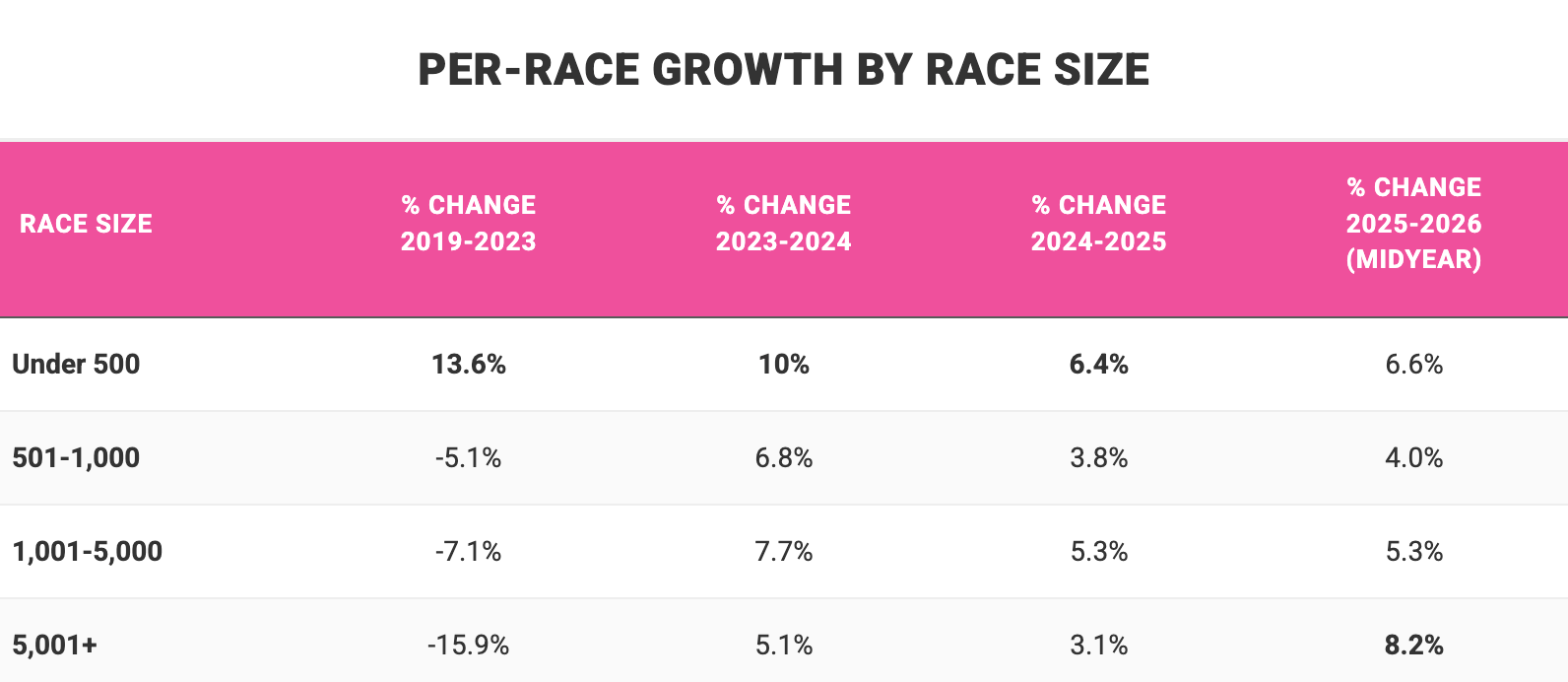
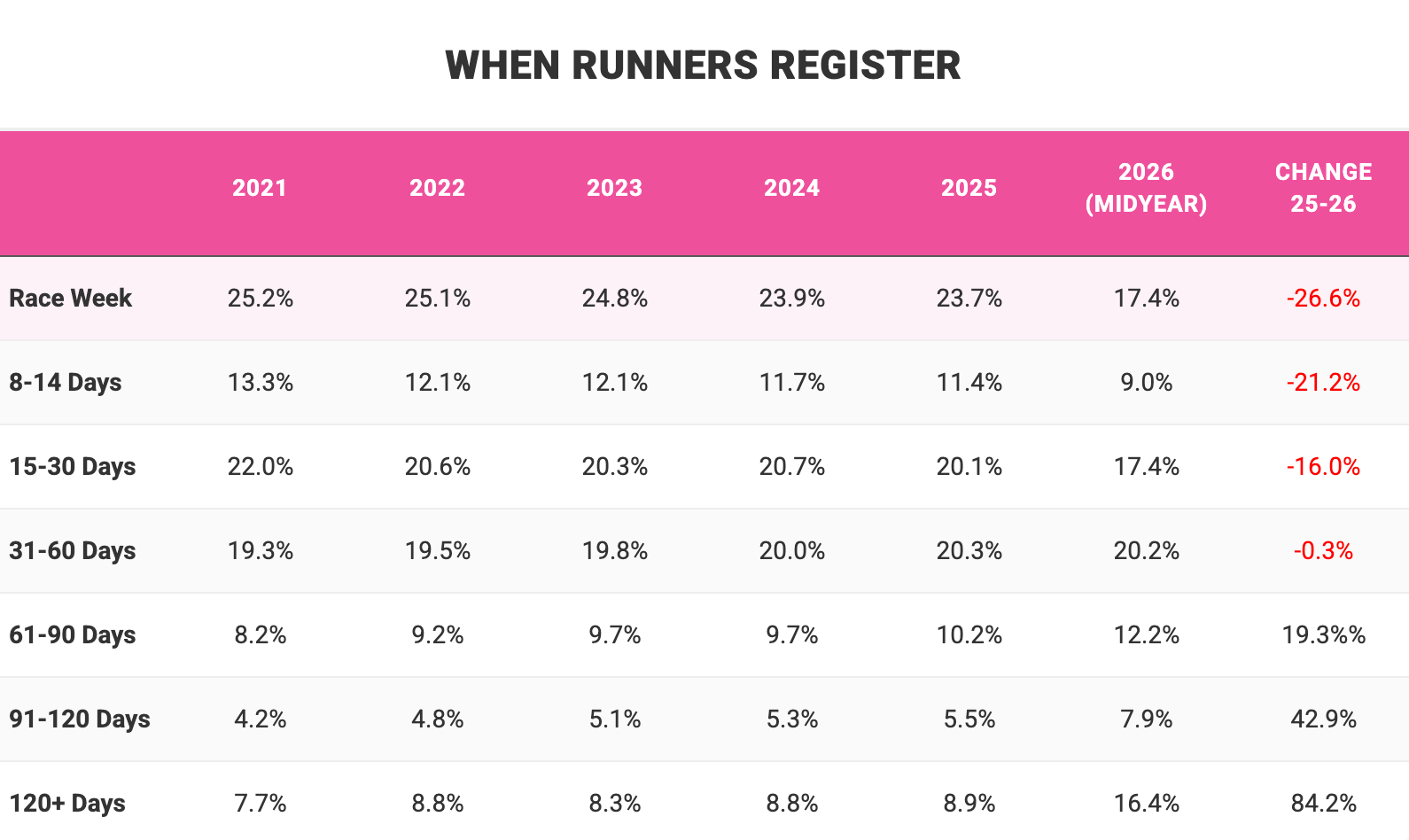
From 2025 through the first half of 2026, average race participation grew by at least 4% for races of all sizes. Large races with over 5,000 participants led the pack with a growth rate of 8.2%. Enthusiasm is also growing. Over the same period the number of participants signing up early for events jumped. Runners registering 120 or more days out were up 84.2%.
Trail running events also saw impressive growth. Registration numbers for the 2026 UTMB World Series Finals in Chamonix showed the same trend. Twenty-nine thousand applications were submitted for the final draw. Seventy-six percent of applicants were European, which says as much about where the sport is concentrated as about how fast it is growing.
Social activations are pushing running culture
Running already has a low barrier to entry, but the proliferation of run clubs reduced that barrier even further. In an age where people are desperate to escape their phones and make genuine connections, run clubs knocked out two birds with one stone. Run club attendance combines exercise with social connection and has even been dubbed the newest dating app alternative. The numbers back it up.
Over the last year Strava running club creation was up 3.5x and global run club memberships were up 59% in 2024. SGI Europe has clearly identified run clubs as the primary entry point for new runners, and running is becoming a more social-driven activity. Seventy-two percent of Gen Z runners join clubs primarily to meet new people, but what starts as a social endeavour quickly leads to more serious commitments. Sixty-nine percent of Gen Z runners raced in 2025 and 76% were considering a race in 2026.
Salomon is a clear market signal
Last week we mentioned a brand that is already joining forces with cycling while benefiting from the running boom. Salomon is an outdoor apparel brand that has seen its footwear products become the bedrock of its business. One company can be an outlier, but shifts in consumer behavior may reveal why Salomon’s business is changing. Salomon is owned by Amer Sports which also owns brands like Arc’teryx and Peak Performance.
Amer Sports is intimately familiar with cycling, owning ENVE Composites for eight years before selling the brand in 2024. That shift away from cycling paired with the latest data in its Q3 investor report, shows how brands living between sports categories are thriving.
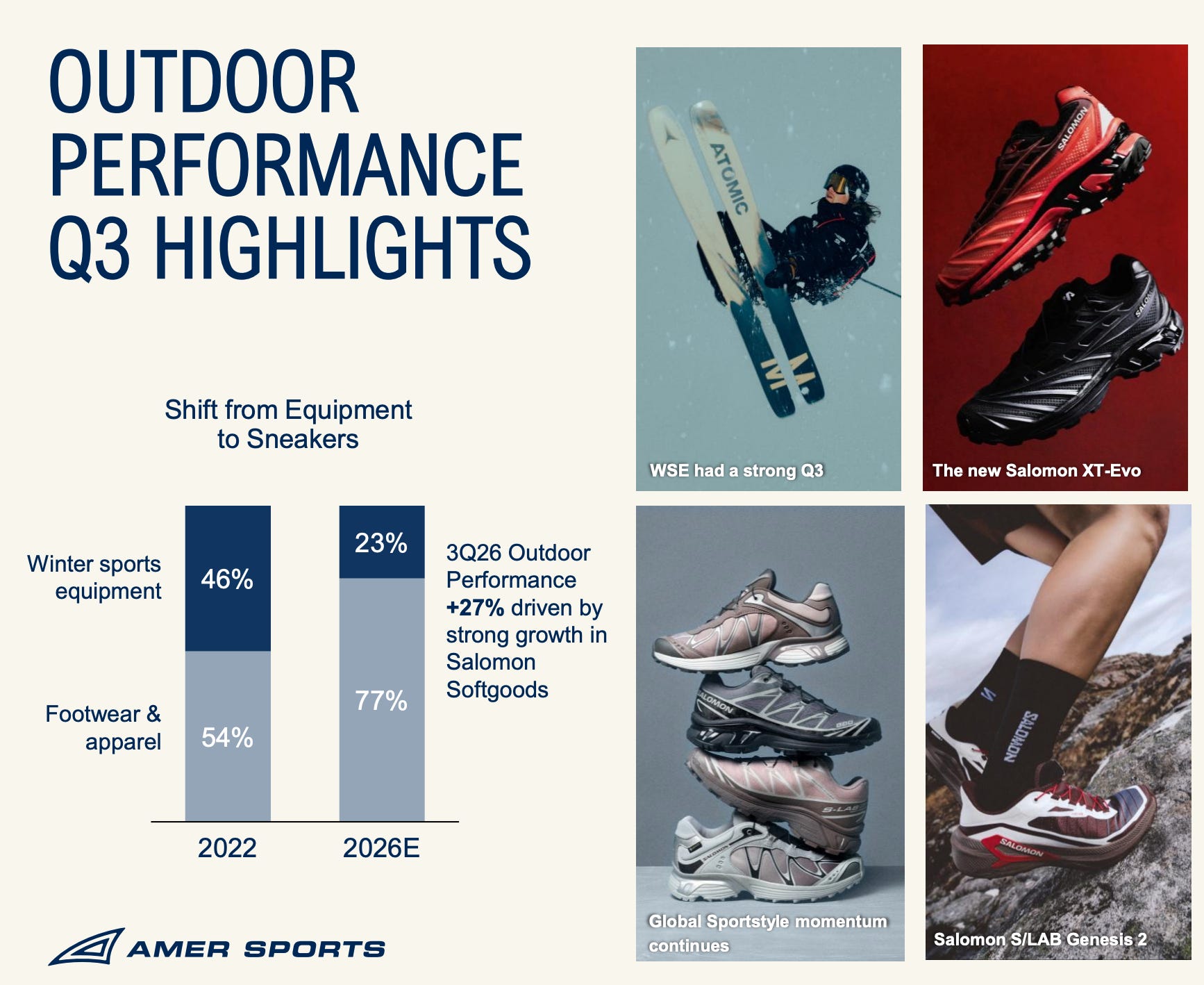
From 2022 to Q3 2026, Amer’s outdoor performance revenues shifted dramatically. Amer splits outdoor performance products into two categories: winter sports equipment, and footwear and apparel. In 2022, 46% of outdoor performance revenues were attributed to winter sports equipment and 54% to footwear and apparel. By 2026 the balance had flipped, with only 23% attributed to winter sports equipment and 77% to footwear and apparel. Armer made sure to highlight that the rise in footwear and apparel could largely be attributed to strong growth in Salomon’s softgoods portfolio.
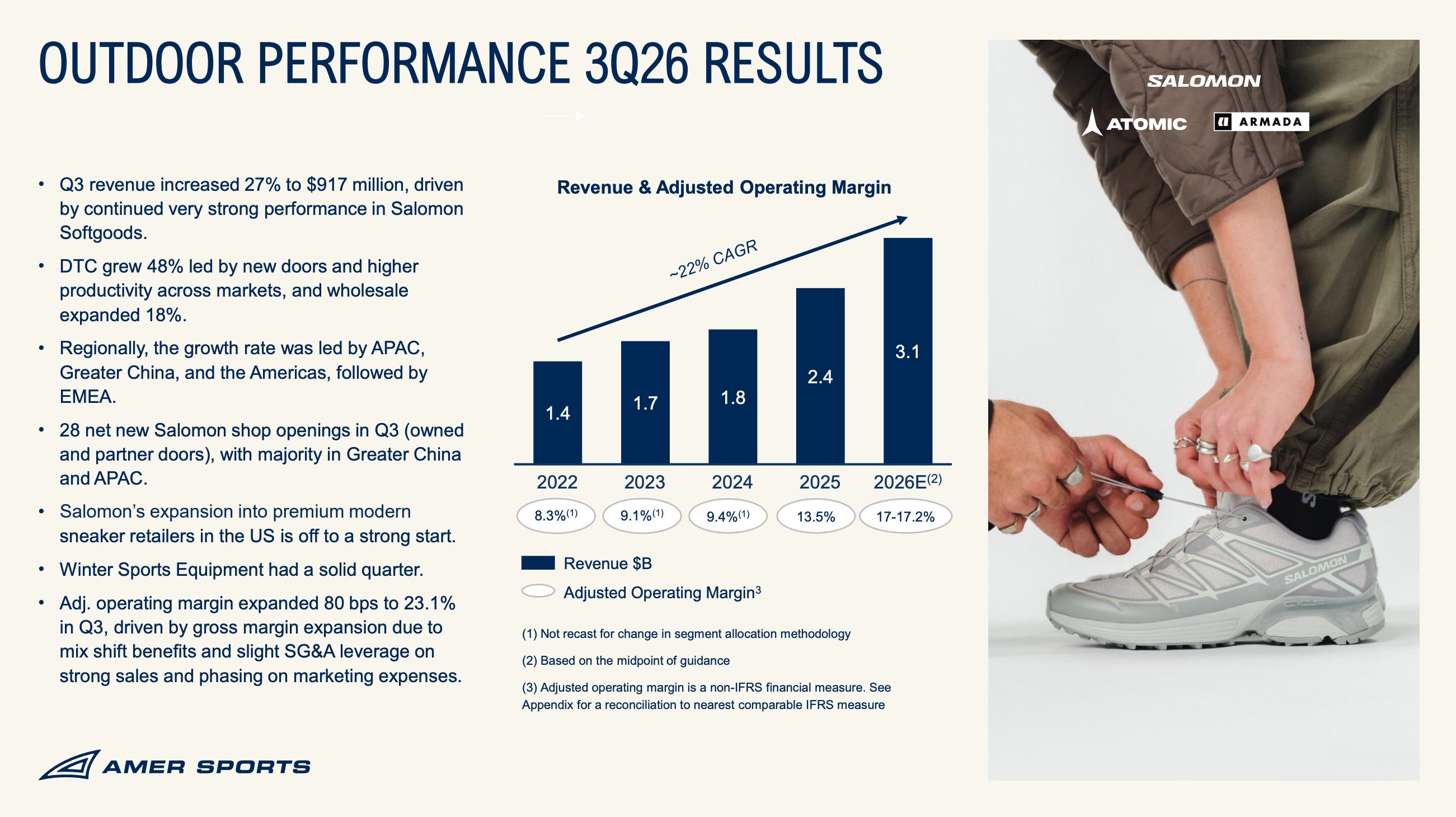
Looking at Salomon’s own business metrics reveals how its investment in footwear has paid off. In Q3 alone, Salomon’s revenue increased by 27% to $917 million. The company’s calculated annual growth rate from 2022-2026 was 22%, with accelerated CAGR in 2025 and 2026 of 13.5% and 17%.
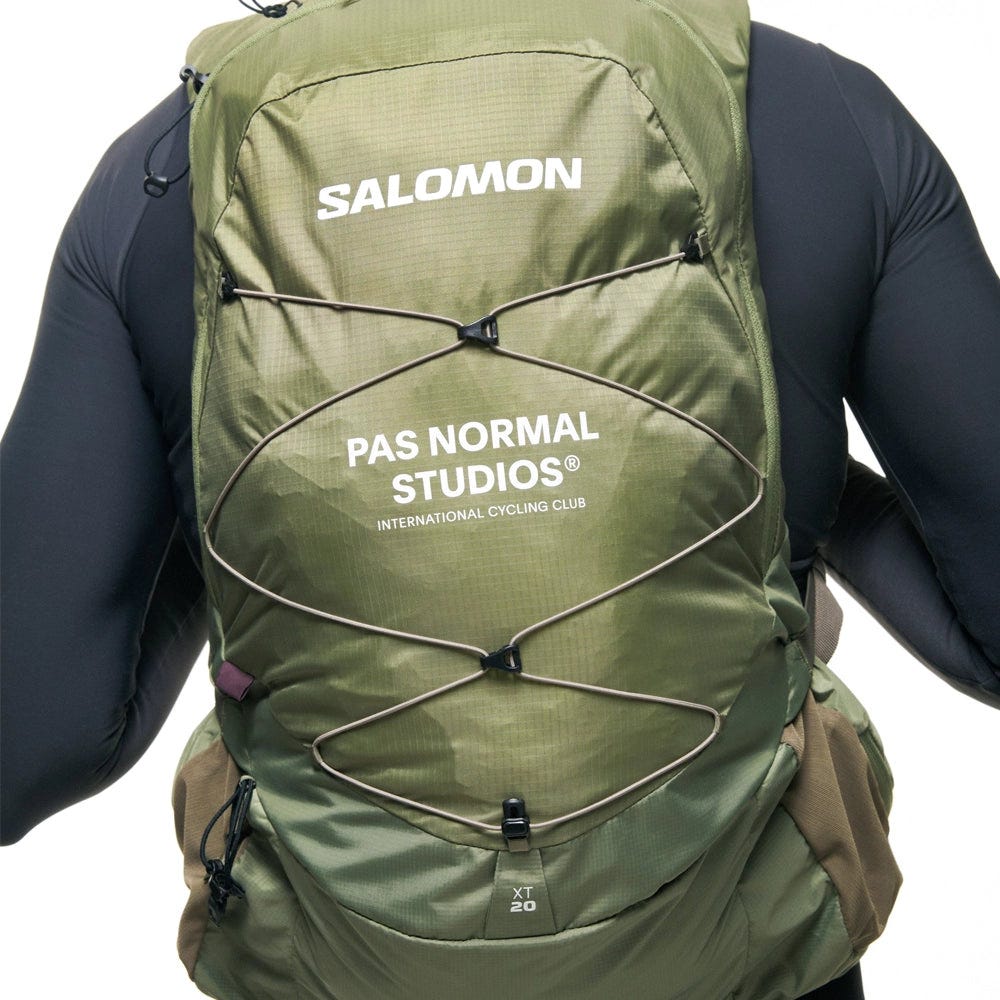
Salomon’s metrics show that the company is executing on the running boom, but its strategic plays show how it understands there is upside to partnering closely with running-adjacent sport disciplines. Earlier this year Salomon signed a five-year partnership agreement with IRONMAN, replacing Hoka as the event series’ premier partner. The brand also made smaller moves by partnering with Pas Normal Studios to align their GRVL shoe with gravel sports, and hosted gravel activations including Gravelanza in Los Angeles and the Shanghai Gravel running event.
A company as big as Salomon seeking alignment with cycling-adjacent sports and themes should be a rallying cry for the cycling industry. Salomon understands that athletes crossing over between sports is becoming increasingly common. According to Strava’s 2025 Year in Sport report, 54% of users record two or more sports and 34% record three or more. Yes, running has a lower barrier to entry, but the demographics driving its growth are the same ones driving growth in certain cycling segments. As it becomes more common to have multiple fitness hobbies, running and cycling have a lot to gain from one another and little to lose.
The play for cycling
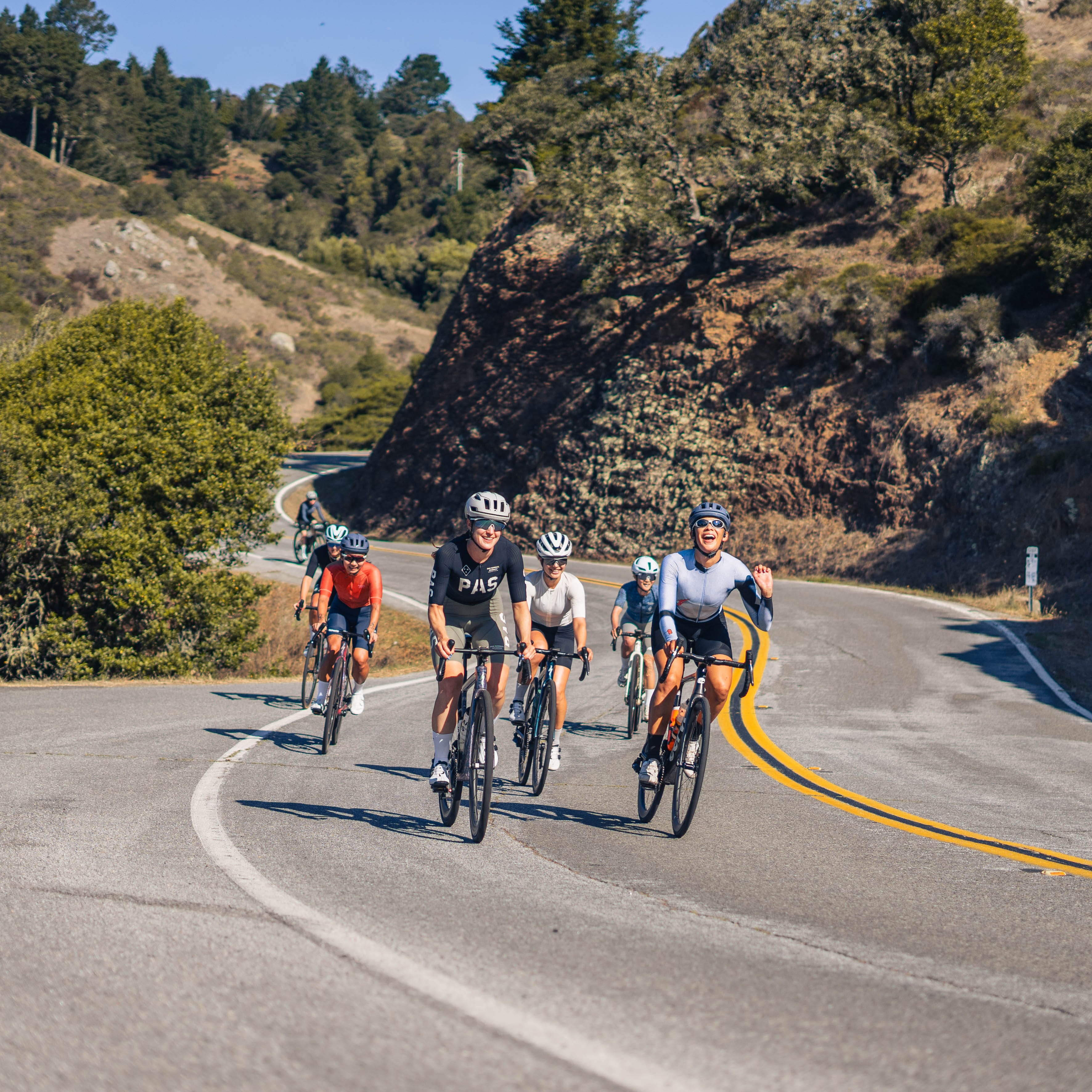
There is already a vast network of successful run clubs across the world, so the work of reaching target demographics is already done for cycling brands. Run clubs are the entry point.
There are multiple approaches to putting products in front of engaged consumers. A cycling brand could approach a run club cold and organize a co-sponsored activation. For instance, a bike brand could approach a well-known run club and offer something to elevate the experience for a given meetup. In return, the run club lets its members know that the bike brand will be in attendance and that anyone who is cycling-curious will have a chance to test ride bikes on a short group ride in place of their normal run.

Another approach is partnering with a local cycling group ride and organizing a joint cycling and run club experience. Cyclists do their normal group ride and runners do their normal run, but on finishing, both groups meet at a designated spot for a social. Inevitably there will be cycling-curious runners who can ask attending cyclists and brand representatives their burning questions and get honest, personalized answers.
Softgoods have a unique opportunity
We have already seen brands like Pas Normal Studios execute on running-centered strategies. Besides partnering with Salomon, the brand has begun releasing cross-training apparel and organizing cross-training runs in place of group rides. Other apparel brands have the opportunity to do the same and tether themselves to a dedicated running partner to bolster their off-the-bike apparel sales. If a shoe brand is large enough, as Salomon is, there is little threat to its clothing lines. Cycling brands will continue to prioritize quality and status, which will not translate to consumers outside of performance culture.
Every off-road cycling event should have run options
We already covered this extensively in my previous trail running piece, but the point is so important is is worth repeating.

The side effects
This is a considerably shorter piece than what I usually write, but I believe the business case for alignment between these two sports is simple and clear. As usual, we are not reinventing the wheel with this stance. Running brands have partnered with professional cycling teams for years, but rarely have we seen partnerships like the one between Pas Normal Studios and Salomon. There needs to be more intentional strategic partnership between large brands.
Coming from the world of tech, I see these partnerships play out daily. Just because two companies sell adjacent products to the same customers does not mean they are threats to each other. Strategic partnerships and platform-specific integrations work across industries, including cycling and running. Mass conversion is not the play. Incremental growth that drives brand loyalty and utility is. The more we align with more popular sports, the sooner we will draw more people to bikes.
Ride and rip,
Kyle Dawes

Love the idea of cycling/running crossover events. I agree there is a lot of overlap and brands could capture and larger and more diverse audience with the same events.
I've always loved the idea of a trail running festival that also includes gravel cycling and vice versa. I know there are some events that feature both in the same weekend, but seems like it could be a great opportunity to bring a larger number of endurance athletes together.
Thanks for the shoutout as well :)
So you're saying my company https://westernspirit.com/ should start offering trail running trips? 🤔